AEO (answer engine optimization) is the part of SEO that prepares your content to be the direct answer to a question: Google’s featured snippet, the “People also ask” block, a voice assistant or an AI answer. AEO and SEO are not rivals: AEO is SEO applied to one specific format, the answer. This article covers what it is, what is documented and how to write an answer block that works.
What AEO means in SEO
An “answer engine” is any system that answers instead of listing links. AEO is the work of writing and ordering content so that system can take your answer as it stands. As with other industry acronyms, it has no official definition: it is a label, not a discipline with published rules.
What does exist and is documented are the formats in which an answer is shown. The clearest is Google’s featured snippet, and from Google’s documentation we know three things about it:
- Google chooses them automatically from web results when it believes they help people find the answer.
- You cannot mark a page to be a featured snippet. No tag or schema switches it on.
- You can opt out with nosnippet or limit its length with max-snippet.
| What it is | Preparing content to be the direct answer to a question |
|---|---|
| Where it shows | Featured snippets, “People also ask”, voice assistants, AI answers |
| Unit of work | One question and its short answer |
| What it is not | An alternative to SEO or markup you can switch on |
AEO vs SEO: what really changes
| Aspect | SEO | AEO |
|---|---|---|
| What you optimise | The page for a search | A block of the page for a question |
| How the query arrives | Keywords | A full question, typed or spoken |
| Result you want | The click from the list | Being the answer shown, with or without a click |
| Prerequisite | Crawling and indexing | The same: answers come from pages that already rank |
| Measurement | Clicks, impressions and position in Search Console | Search Console has no dedicated featured snippet report: you check by searching |
As for GEO, the distinction in one sentence: AEO formats the direct answer to a question, while GEO is about generative engines using and citing you as a source when they compose an answer from several pages; we explain it in GEO (generative engine optimization).
How to structure answers step by step
This is the pattern we use. It is not a Google rule: it is a way of making life easy for any system that has to extract a piece of text and show it on its own.
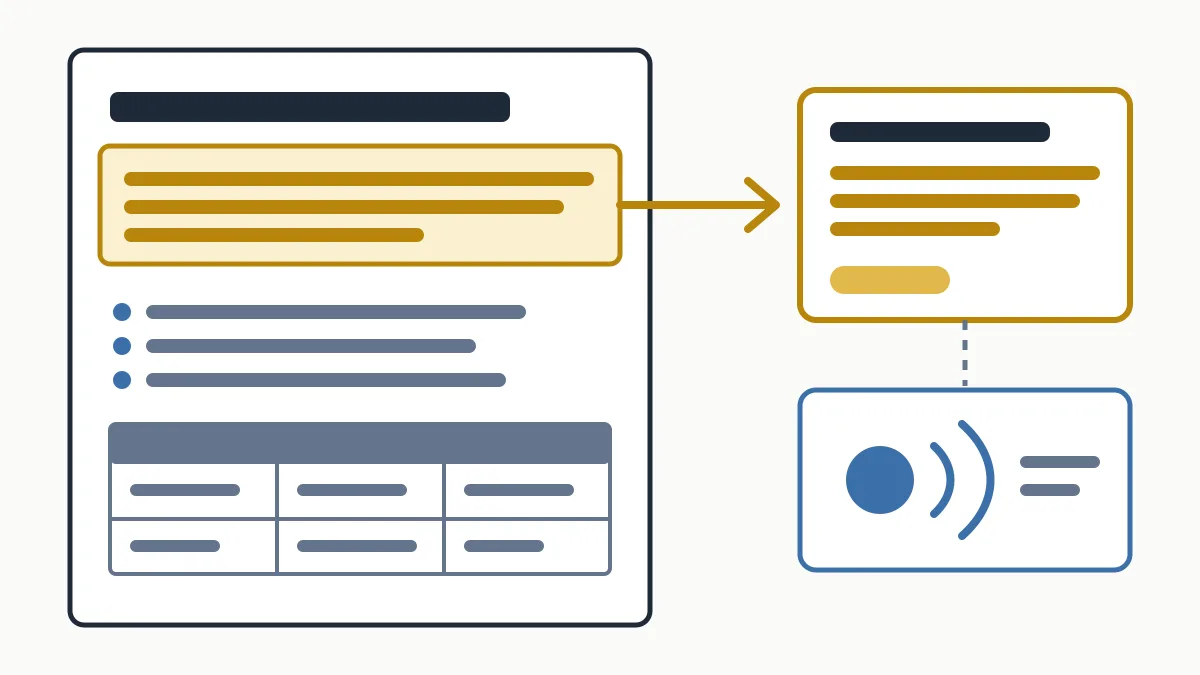
- The literal question as a heading (H2 or H3), written the way the customer asks it, not the way you would say it.
- The direct answer right beneath it, in two or three sentences that stand alone. Start with the answer, not the context.
- The format the question calls for (see the table).
- Then the detail: nuances, exceptions, an example.
- One question per block. If you answer three in one section, none of the three comes out clean.
| Type of question | Format that fits | How the answer starts |
|---|---|---|
| What is… | Definition paragraph | “X is…” |
| How do you… | Numbered list of steps | Summary sentence, then steps |
| What is the difference… | Comparison table | The main difference in one sentence |
| How much or how long… | A range and what it depends on | “Between… and…, depending on…” |
| Can I…? Do I need…? | Yes or no, plus the condition | “Yes, provided…” or “No, unless…” |
An example with a joinery in Terrassa and the question “How long does it take to install a fitted kitchen?”.
- An answer that cannot be extracted: “Our company has been devoted to kitchens for many years and every project is unique, which is why we study each case…”
- One that can: “Between [your real timescale] from the day we measure up: manufacturing takes most of that time and fitting takes [your days]. It takes longer if water or electrical installations have to be moved.”
The second starts with the fact, says what it depends on and makes sense without reading anything else. The brackets are yours: put in the timescale you actually meet.
Structured data and FAQs: what to expect
This is where most false expectations sit, so here is what is documented:
- In 2023 Google restricted FAQ rich results to well-known, authoritative government and health websites, and withdrew HowTo rich results. Adding FAQPage markup to a small business site will not produce expandable questions in the results.
- Structured data has to describe content visible on the page. Marking up questions the user cannot see goes against Google’s guidelines.
Our judgement: a visible FAQ block is still worth having, because it settles real doubts and is clean text in question-and-answer form. The markup does no harm, but it is not what does the work. The types that do make sense are in the structured data guide.
Common mistakes
- The buried answer. Three paragraphs of introduction before answering.
- Invented questions. Nobody searches for “Why are we the best option?”. The real questions are in the Search Console performance report: filter queries containing “what”, “how”, “how much” or “when”. If you have never used it, start with how to use Google Search Console step by step.
- Vague answers. “It depends” without saying on what.
- The same question on twenty pages. You end up competing with yourself, which is keyword cannibalisation.
- Text that is not in the HTML. If the answer only loads when the user clicks and is not in the code the crawler receives, it cannot be read.
Where to start in one afternoon
- Write down the ten questions you are asked most by phone or email before people hire you.
- Check in Search Console which ones already bring impressions and on which page.
- On each page, make the question the heading and rewrite the first sentence so it is the answer.
- Choose the format from the table and delete everything between the question and the answer.
- A few weeks later, search for the questions and see what is shown.
If you would like us to review which of your customers’ questions you are already close to answering on Google, request the free initial analysis. And if what you need is someone to write those blocks, see our SEO content service.
Frequently asked questions
Are AEO and SEO the same thing?
Not exactly: AEO is a part of SEO. SEO works on getting the page crawled, indexed and ranked; AEO on making a block of that page showable as a direct answer.
Can I choose for my page to appear as a featured snippet?
No. Google chooses them automatically and documents that you cannot mark a page to be one. The only control you have is the opposite: opting out with nosnippet or limiting the snippet with max-snippet.
Is FAQPage schema useful for a small business?
Not for getting expandable questions on Google: since 2023 that rich result has been reserved for authoritative government and health sites. The visible question block is useful, for its text.
Will AEO cost me clicks?
On questions settled by a definition, the user may not click. That is why it is worth focusing on questions whose answer leads to needing your service.