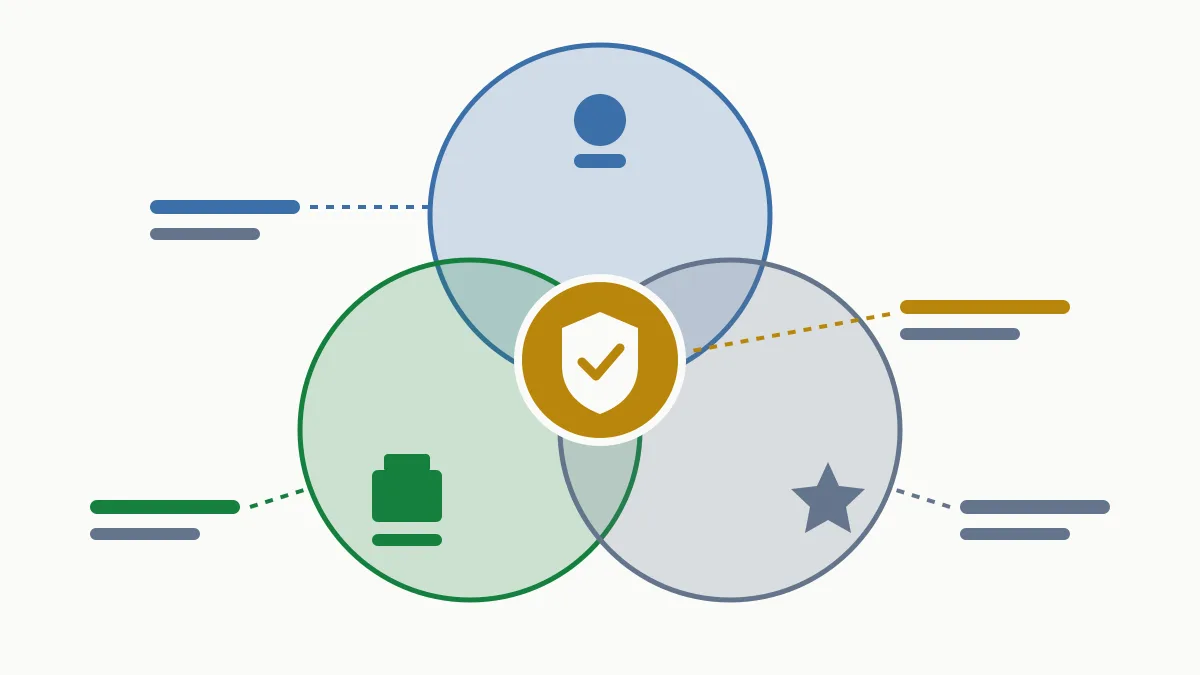
EEAT in SEO stands for Experience, Expertise, Authoritativeness and Trust: the four criteria Google’s quality guidelines use to describe whether content deserves to be trusted. It is not a score and it is not a direct ranking factor: it describes what Google’s systems try to reward. For a small business it comes down to something very concrete: showing who is behind the site and why they know what they are talking about.
What E-E-A-T is, letter by letter
| Letter | Question it answers | What it looks like in a small business |
|---|---|---|
| Experience | Has the writer done, used or lived this? | Your own photos of jobs, details only someone who does the work knows |
| Expertise | Do they have the necessary knowledge or training? | Qualifications, professional registration, years in the trade, specialism |
| Authoritativeness | Do others recognise them as a reference? | Mentions and links from trade bodies, professional associations or local press |
| Trust | Is it accurate, honest and safe? | Company details, real contact information, clear terms and prices |
Two documented facts: the first E, for experience, was added to the guidelines in December 2022, and Google says that of the four, trust is the most important: the other three exist to support it.
What Google actually looks at (and what it does not)
There is a lot of confusion about what EEAT is inside Google, so let us start with what its own documentation says:
- It comes from the Search Quality Rater Guidelines, a public document.
- Raters do not move the ranking of any page. Google uses their ratings to check whether its systems are working well.
- E-E-A-T is not, in itself, a specific ranking factor. Google explains that its systems use a mix of factors that help identify content with good E-E-A-T.
- It weighs more on sensitive topics. On what Google calls “Your Money or Your Life” (health, money, safety), its systems give even more weight to these signals.
- It asks for clarity on the who, how and why of content: who created it, how it was made and for what purpose.
How to show EEAT on a small business website
A small business has an advantage a generic portal lacks: it actually does the work. The problem is that the website often fails to show it. These are the four fronts.
1. Authorship
Google recommends making it clear who created the content, with a byline where the reader would expect one and a link to more information about the author. In practice:
- Sign articles with a full name, not “Admin” or the company name.
- Create a short author page: training, years in the trade, specialism, registration number if there is one.
- If a professional (a doctor, a lawyer) has reviewed a text, say so and say who.
2. Evidence of experience
This is our own judgement: experience is shown through what cannot be copied.
- Your own photos of jobs, premises and team, not stock images.
- A process explained in detail: what you check first, what usually goes wrong, what you advise against and why.
- Jobs with context: where, what the problem was and how it was solved, with the customer’s permission.
A renovation company in Sabadell that explains why it will not lay wooden flooring in a windowless bathroom shows more experience than one that writes “we work with the best materials”.
3. Reviews and reputation
The guidelines ask raters to look for what independent sources say about the business, not only what the business says about itself. For a small business, the most visible independent source is its Google Business Profile:
- Real, recent reviews that are answered, including the bad ones. The method is in how to get Google reviews and the day-to-day handling in Google reviews: a practical system.
- A presence in your trade body, professional association or local traders’ association, with a link to your site.
- No invented testimonials: fake reviews are against Google’s policies.
4. About page and contact details
The guidelines tell raters to check who is responsible for the site and how they can be contacted. In addition, Spain’s information society services law already requires a business website to identify its owner. An “About us” page that does its job includes:
- Registered name, tax number, address and a phone someone answers.
- The people, with name, role and a real photo.
- How long you have been working and in which area.
- Legal notice and terms that are easy to find.
| Action | Where | Effort |
|---|---|---|
| Byline with a real name | Every article | Low |
| Author page | Blog | Low |
| About page with people and company details | Corporate site | Low |
| Your own photos of jobs | Services and blog | Medium |
| Real, answered reviews | Google Business Profile | Medium, ongoing |
| Mentions from trade bodies or local press | Off the site | High |
Mistakes that erode trust
- Articles signed by “Admin” or not signed at all.
- An “About us” that says “we are a young, dynamic team” and names nobody.
- Stock photos passing off people who do not work there as the team.
- Badges, awards or customer figures that cannot be checked.
- Testimonials with no name and no way to verify them.
- Fictional authors with inflated biographies.
- Writing about topics outside your trade just because they get searches.
When it matters most
If your business touches health, money or legal matters, all of this stops being advisable and becomes essential: that is where Google says it gives these signals more weight. Clinics, law firms and financial advisers should treat authorship and credentials as part of every page, not only the blog. We go sector by sector in the guides to SEO for clinics and SEO for lawyers.
And a piece of our own reasoning, not a published rule: the same clarity about who you are and what you do is what a generative engine needs in order to cite you as a source. We explain it in GEO (generative engine optimization).
If you want to know which of these pieces of evidence your site is missing, request the free initial analysis and we will list them in order of priority.
Frequently asked questions
Is EEAT a ranking factor?
Not directly. Google says E-E-A-T is not in itself a specific factor, but that its systems use a mix of factors that help identify content that meets it.
How can I measure my site’s EEAT?
There is no official metric and no Google tool that scores it. What you can do is go through a checklist: visible authorship, evidence of experience, real reviews and complete company details.
Do I need author schema to have EEAT?
Structured data helps Google understand who the author is, but it does not replace visible evidence. No markup “grants” EEAT if the page does not show who is behind it.
Does it affect a small local business too?
Yes, especially if it touches health, money or legal matters. But that is where it is easiest: a small business has real people, jobs and customers to show.