What is keyword stuffing? In one sentence: filling a page with keywords repeated unnaturally in an attempt to climb Google’s rankings. Google covers it in its spam policies, and a page that falls into it may rank lower or stop appearing in results. It is not about how many times you write a word, but about whether the text is written for the reader or for a crawler.
What keyword stuffing is according to Google
Google’s spam policies define it as the practice of filling a page with keywords or numbers to manipulate rankings, and give three examples:
- Lists of phone numbers with no added value.
- Blocks of text listing cities and regions the page is trying to rank for.
- Repeating the same words or phrases so often that the text sounds unnatural.
Notice what is missing: any figure. Google does not publish a keyword density, recommended or maximum. The test is the intent to manipulate and the unnatural result, not a percentage.
Keyword stuffing examples (and the correct version)
The examples are made up, using a plumber in Sabadell, but the patterns are the ones found on many local business websites.
| Where | With keyword stuffing | Correct version |
|---|---|---|
| Body text | “We are plumbers in Sabadell. If you are looking for plumbers in Sabadell, our plumbers in Sabadell are the cheapest plumbers in Sabadell.” | “We have been plumbers in Sabadell for fifteen years. We deal with breakdowns the same day in the centre, la Creu Alta and Can Rull, and give you the price before we start.” |
| Page title | “Plumber Sabadell | Plumbers Sabadell | Cheap Plumbing Sabadell” | “Plumber in Sabadell: 24-hour call-outs and no-obligation quotes” |
| Footer | Thirty links reading “plumber” followed by a different town | One service area page with the towns and the real travel conditions |
| Image alt text | “plumber sabadell cheap plumbers sabadell emergency plumber” | “Replacing a water heater in a flat in Sabadell” |
| Hidden text | Keywords in white on a white background | Nothing: if nobody is meant to read it, it should not be there |
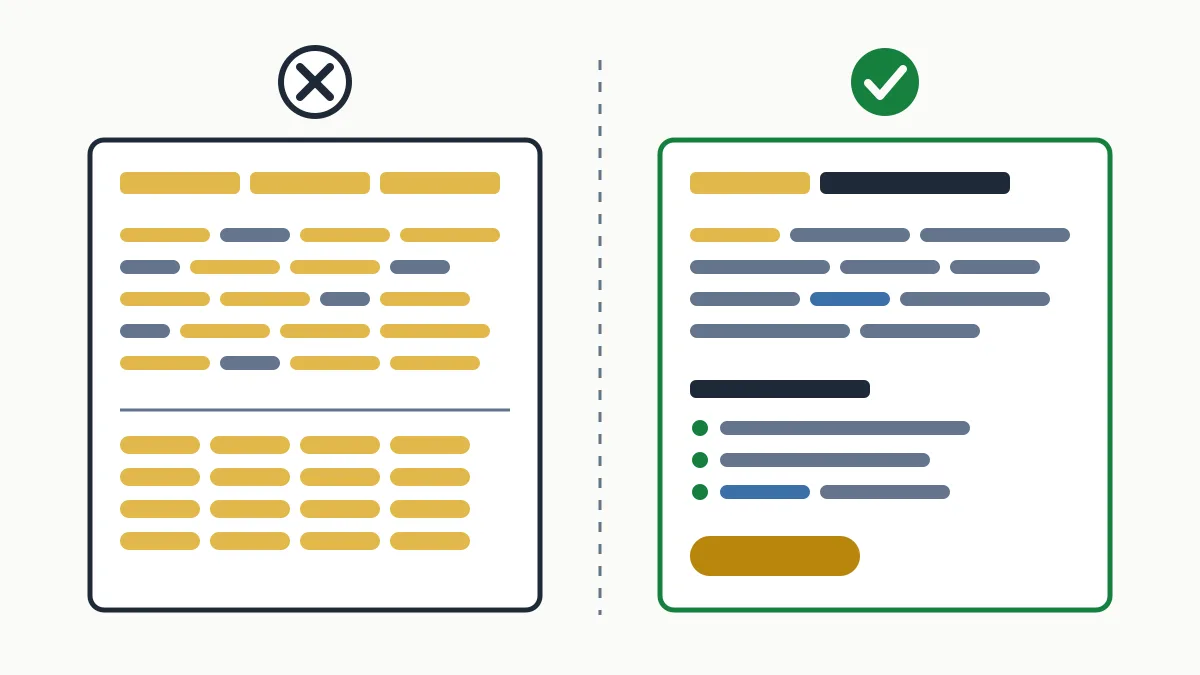
Three documented notes on these cases:
- Titles. Google recommends avoiding keyword stuffing in titles and warns that it may generate a different one to show in results. There are patterns that work in SEO title examples.
- Images. Its documentation asks you not to fill the alt attribute with keywords: it makes for a worse experience and may cause the site to be seen as spam.
- Hidden text. It is a separate spam policy, but from the same family.
And one myth: the meta keywords tag. Google explained years ago that it does not use it for ranking in web search. Filling it achieves nothing.
Why it gets penalised
What Google’s documentation says:
- Sites that violate the spam policies may rank lower or not appear in results at all.
- Detection relies on automated systems and, where needed, human review, which can end in a manual action.
- Manual actions are shown in Search Console, in the “Manual actions” report. Once the problem is fixed, you can request reconsideration there.
- If the adjustment is automatic, you receive no notice: the page simply does not climb.
And what we add ourselves, as reasoning rather than data: even if no sanction arrives, stuffed text reads badly. Visitors do not find what they were looking for stated clearly, do not call and do not ask for a quote. Keyword stuffing is expensive even when Google does nothing.
How to spot it on your site
- Read the page aloud. If you stumble over the same expression, it is surplus.
- Search for the keyword within the page (Ctrl+F) and see where it lights up. If it appears in nearly every sentence of a paragraph, rewrite it.
- Check the places where it piles up unnoticed: title, headings, image alt text, footer and menus.
- Ask the deletion question: if Google did not exist, would you keep this sentence? If the answer is no, remove it.
- Look at the “Manual actions” report in Search Console. If you have never opened it, the route is in how to use Google Search Console step by step.
Where we find it most often is on older sites that someone “optimised” years ago and in footer text nobody has looked at since.
What to do instead
The opposite of keyword stuffing is not hiding the keyword, but using it where it belongs and then writing normally. What we recommend, as house practice:
- One main search per page, clear in the title, the main heading and the first paragraph. That is enough for Google to know what the page is about.
- Topic vocabulary instead of repetition. Synonyms, specific services, related questions. To find the words people really use, follow how to do keyword research step by step or see our guide to keyword research with AI.
- Answering the intent: someone searching “emergency plumber Sabadell” wants to know whether you can come now and what it costs, not to read the word “plumber” twenty times. We explain it in search intent in SEO.
- Service areas with real content. If you work in several towns, explain it on one area page or on pages that each say something specific about the place. Many near-identical pages that only change the town name are a separate problem covered by Google’s policies (doorway pages).
- Rewrite rather than delete. Take the stuffed paragraph, keep one mention and fill the space with what the customer wants to know: timescales, indicative prices, what is included.
If you would like us to check whether your site has over-optimised text and which pages are worth rewriting first, request the free initial analysis. And if you would rather we write the copy, see our SEO content service.
Frequently asked questions
How many times can I repeat a keyword?
There is no number. Google publishes no limit and no recommended density. The test is whether the text sounds natural to the reader: if the repetition grates when you read it aloud, there is too much.
What is the ideal keyword density?
None is documented. The figures in circulation do not come from Google. It is better to put the main search in the title, the heading and the first paragraph, and then write normally.
How do I know whether Google has penalised me for keyword stuffing?
If there is a manual action, it appears in the “Manual actions” report in Search Console. If the adjustment is automatic there is no notice, and the only sign is that the pages do not rank.
Does the meta keywords tag count for Google?
No. Google explained that it does not use the meta keywords tag for ranking in web search, so filling it with words adds nothing.