Content marketing means attracting and persuading customers by publishing useful content — articles, guides, videos, case studies, newsletters — that answers what your audience is already searching for, instead of interrupting them with ads. For a small business it does three things: it gets you found on Google, it builds trust before anyone asks for a quote, and it frees you from paying for every visit.
This guide gives you a plain definition, the formats worth considering with a small team, a five-step plan and what to look at to know whether it is working. It is written for businesses of one to twenty people, not for marketing departments.
What content marketing is (and is not)
It is a way of winning customers in which the content does the selling: it settles a real doubt, shows that you know your trade and leaves the reader one step away from contacting you. The difference from advertising is who starts the conversation. With an ad, you start it; here the customer starts it when they type their question into Google, YouTube or an AI assistant, and you show up with the answer.
What it is not:
- It is not publishing for the sake of it. One article a week on topics nobody searches for is work with no return.
- It is not talking about yourself. Company news (“we attended a trade fair”) interests people who already know you; it does not bring new customers.
- It is not only the blog. The blog is the most common format, but a well-explained service page, a calculator or a documented case study is content too.
- It is not immediate. Results arrive in months, not days (see how long SEO takes to work).
What content marketing does for a small business
What I usually find when I review a local business website is a home page, a services page and a contact page. With that, you can only appear for people who already search for your name or for one very specific service. Everything the customer asks before deciding is left to someone else.
Three scenarios to make it concrete:
- An accountancy firm in Sabadell that explains which expenses a freelancer can deduct receives visits from freelancers who are not yet looking for an accountant, but will need one.
- A physiotherapy clinic in Tarragona with a guide to recovering from a sprain answers what the patient wonders before booking an appointment.
- An online shop in Girona selling mountain gear that compares types of boots reaches people who have not yet decided what to buy or where.
There is a fourth, less visible benefit: content saves sales time. If the same question reaches you by phone every week, a page that answers it well is something you can send by email or WhatsApp, and the customer arrives at the first meeting halfway there.
Content marketing formats: which one to choose
You do not need to be everywhere. With a small team, one format done well beats five done by halves. This table sums up the ones I use most with small businesses:
| Format | What it is best for | Effort | When to choose it |
|---|---|---|---|
| Articles and guides on your site | Capturing Google searches and AI answers | Medium | Almost always: it is the base and the only piece you own |
| Expanded service pages | Converting people already comparing suppliers | Low | If your service pages are three lines long |
| Case studies and work examples | Building trust before the quote | Medium | High-value services: renovations, law firms, B2B |
| Short video | Showing a process or a result | Medium-high | If the work is easier to understand by watching it |
| Email newsletter | Staying in touch with people who already know you | Low | If there are repeat purchases or long decisions |
| Social media | Distributing all of the above | Low-medium | As a loudspeaker, not as your only channel |
My recommendation to start with: your website first. What you publish on your own domain stays there, keeps receiving visits while it is useful, and can be cut up later for social media or the newsletter. It does not work the same the other way round: a social post drops out of the feed within days. If your format is going to be the blog, I explain how to approach it in corporate blog.
How to plan content marketing in 5 steps
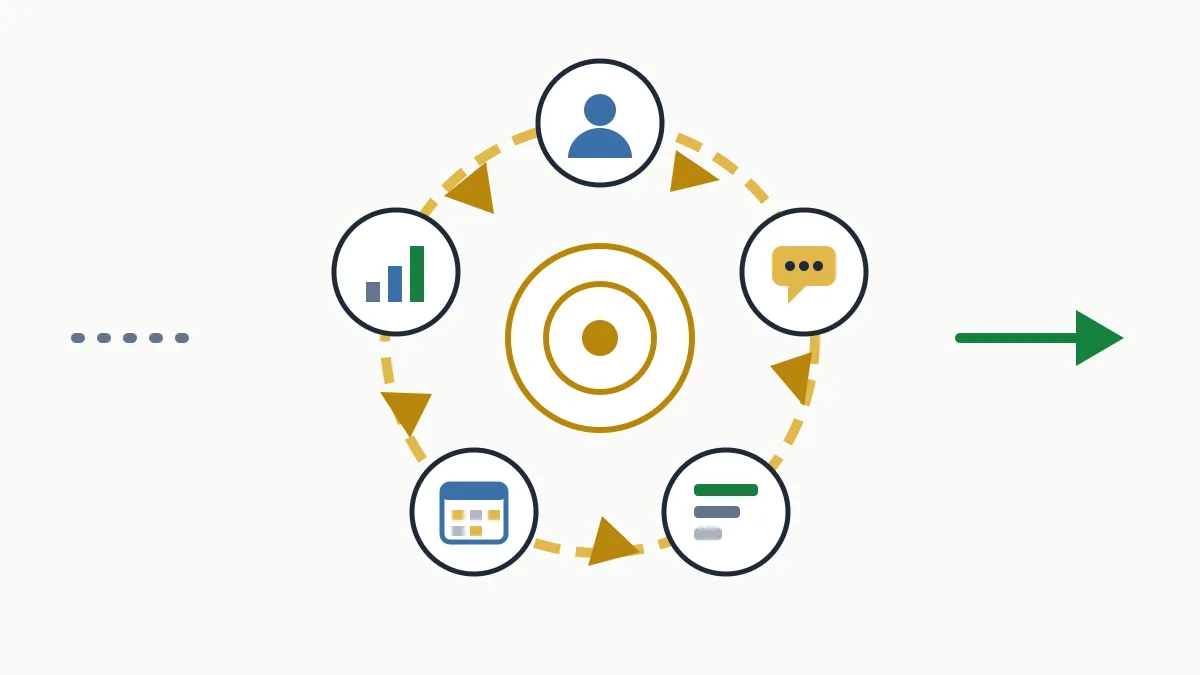
- Define who you want to attract and why. “More visits” is not a goal. “More quote requests for bathroom renovations in the Vallès area” is, and it shapes everything else.
- Write down your customers' real questions. The ones you get by phone, over the counter and by email. Complete the list with the queries already showing in Google Search Console and with the long-tail keywords in your sector: more specific searches with less competition.
- Sort by closeness to the sale. First what people search for when they are about to hire (prices, comparisons, “how long does it take”), then the earlier doubts. Most businesses start the other way round, which is why the blog brings no customers.
- Set a pace you can keep. Two good pieces a month for a year are worth more than ten in January and silence until September. Reserve part of the calendar for evergreen content, the kind that does not expire.
- Publish, link and review. Every piece should link to one of your services and to related pieces, and have a clear next action. How to write it so it ranks is covered in how to write SEO articles that rank.
If you do not have time for the whole cycle, the hardest part to delegate is the first one: knowing what your customers ask. Writing and publishing can be outsourced; that is what we do with our SEO content service.
How to measure whether content marketing works
Measure in two stages, because content takes time to mature:
| What to look at | Where | What it tells you |
|---|---|---|
| Impressions and clicks per page | Google Search Console | Whether Google shows the piece, and for which queries |
| Average position for target queries | Google Search Console | Whether you are climbing or stuck |
| Visits arriving from search engines | Google Analytics | Which pieces really bring traffic |
| Enquiries that start on a piece of content | Forms, calls, analytics | The only figure that pays the bills |
In the first months, look at the first two rows: if impressions are growing, you are on track even without enquiries yet. After that the question changes: which pieces bring requests? To find out, ask every new customer how they found you and write it down; in a small business that is more reliable than any report. The detail of which metrics to watch and in what order is in how to measure SEO results.
Common mistakes that stop it working
- Writing about what you feel like rather than what people search for.
- Not linking to your services. An article with visits and no path to contact is a missed opportunity.
- Giving up after three months, just before it starts to show.
- Publishing several pieces on the same thing, which end up competing with each other.
- Not updating. A guide with prices or steps from three years ago erodes trust.
- Mass-producing text without reviewing it. AI helps with drafting, but what sets your content apart is what you know about your trade; without that, it reads like everyone else's.
Frequently asked questions
What is the difference between content marketing and SEO?
Content marketing decides what you publish and for whom; SEO makes that content findable on Google. They need each other: content without SEO goes unread, and SEO without content has nothing to rank.
How long does it take to produce results?
It is a matter of months. First impressions on Google can arrive within a few weeks, but steady traffic and enquiries usually need six to twelve months of regular publishing, depending on how competitive the sector is.
Do I have to publish every week?
No. Regularity and quality matter more than frequency. Two well-chosen, well-crafted pieces a month are a good starting point for a small business.
Can I do content marketing without a blog?
Yes: with complete service pages, case studies, downloadable guides or video. Even so, a blog is usually the simplest way to answer many different questions on your own site.
Where to start this week
Write down the ten questions customers ask you most, sort them by closeness to the sale and write the first one with everything you know. That is the minimum plan, and it beats most fifty-idea calendars that never get done.
If you want to know what your audience searches for and which gaps your competitors leave, ask for the free initial analysis: we review your site and tell you which content we would start with.