Evergreen content answers a question that does not expire: it stays useful and keeps being searched for months or years after publication, with only occasional touch-ups. A guide to choosing a boiler is evergreen; the news of a grant with a deadline is not. For a small business it is the part of the blog that pays back most per hour invested.
Here is how to recognise it, examples by sector, how it compares with topical content and, above all, how to keep it alive, which is where almost everyone fails.
What evergreen content is
The name comes from evergreen trees, which stay green all year round. Applied to a website, it is a piece that meets three conditions:
- The question keeps coming up. New people ask it every month, not only this week.
- The answer changes little. It may need adjustments (a price, a step, a screenshot), but it does not have to be rewritten from scratch every year.
- It does not depend on a date. Not in the title, not in the angle, not in the examples.
Evergreen does not mean eternal or untouchable. It means the effort of creating it pays back over a long time, provided someone reviews it. Nor is it a format: it can be a guide, an FAQ page, a glossary, a comparison or a video.
Examples of evergreen content by sector
The quickest way to grasp it is to look at pairs. On the left, pieces that will still receive visits two years from now; on the right, pieces from the same business that expire:
| Business | Evergreen | Not evergreen |
|---|---|---|
| Accountancy firm in Sabadell | Differences between sole trader and limited company | What is new in this year's tax return campaign |
| Dental clinic in Tarragona | What to do if a filling falls out | This month's whitening promotion |
| Renovation company in Girona | Steps and order of a kitchen renovation | This season's colour trends |
| Online coffee shop | How to store coffee beans at home | Black Friday offers |
| Restaurant in Gràcia | How to get there, parking and group menus | Valentine's Day special menu |
There is an in-between case worth knowing: recurring seasonal content. “When to prune an olive tree” is only searched for a few months, but it comes back every year with the same answer. Treat it like evergreen: a single URL you review before each season, not a new article every year.
Evergreen or topical: which suits you
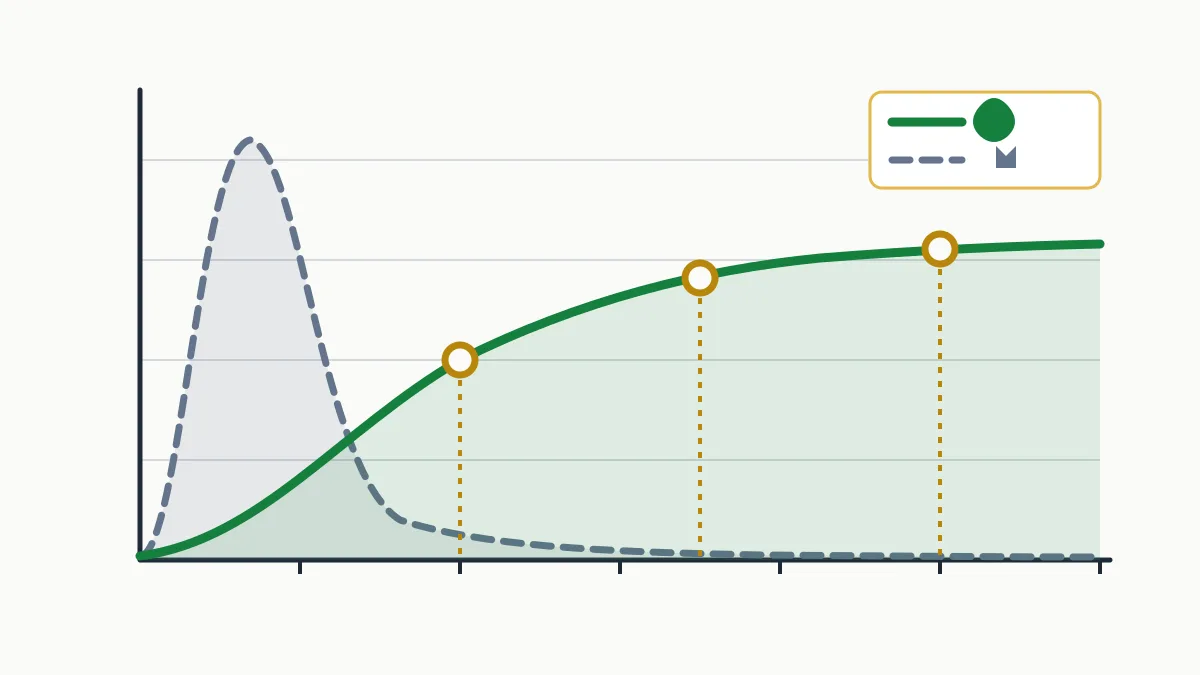
They are not enemies; they do different jobs. Topical content gives you a spike in visits and shows you are up to date. Evergreen content builds a base that does not collapse when you stop publishing.
| Evergreen | Topical | |
|---|---|---|
| Traffic pattern | Grows slowly and holds | Quick spike, then a drop |
| Main channel | Search engines | Social media, newsletter, news |
| Useful life | Years, with reviews | Days or weeks |
| Initial effort | High: it has to be the best answer | Low or medium: speed matters |
| Maintenance | Periodic review | None, or removal once it expires |
My recommendation for a small business short on time: most of the calendar, evergreen, and topical pieces only when a development truly affects your customers (a change in regulations, a new grant). In that case, link the news item to the evergreen guide on the same subject, so the spike feeds the piece that stays. How to split the calendar within the overall plan is explained in content marketing.
How to create evergreen content
- Choose questions that keep coming up. The ones you hear every month at the counter or on the phone, and the queries that appear steadily all year in Google Search Console, not in a single spike.
- Answer at the very top. The direct answer in the first lines; the detail afterwards. That is what both the reader and Google's AI summaries need.
- Remove dates where they are not needed. No year in the title or the URL if the answer does not depend on it. A slug like /how-to-choose-a-boiler ages better than /how-to-choose-a-boiler-2026.
- Isolate what expires. Put prices, deadlines and legal references in a table or a section of their own. When they change, you update that block and leave the rest alone.
- Make it complete, not long. It has to settle the question and the two or three that come right after. The writing technique is in how to write SEO articles that rank.
- Link to it from visible places. From the menu or related service pages, and from every new article that touches the subject. An evergreen piece buried on page 7 of the blog stops getting attention.
If you already have a blog, look at what you have before writing anything new: the evergreen piece often already exists, spread across three short articles that can be merged. Corporate blog shows how to fit it into the structure.
How to keep evergreen content up to date
This is where it is won or lost. A guide that was the best three years ago and that nobody has touched ends up overtaken by a newer, more complete one. The routine I recommend:
What to check in each review:
- Data that expires: prices, deadlines, regulations, menu names and screenshots.
- Broken links or links pointing to pages that no longer exist.
- New questions: in Search Console, look at which queries the page is shown for. If some appear that the text does not answer, add a section.
- Signs of wear: if the page's clicks fall for several months running with no seasonal reason, it needs a thorough review.
- Examples: replace the ones that have dated.
Two rules to avoid hurting yourself. First: keep the URL. If you change it, you lose what the page has built up and you need a redirect. Second: change the date only if you have changed the content. Google's guidance on helpful content explicitly mentions, as a bad practice, changing the date to make a page look fresh when the text has not substantially changed.
A piece nobody reviews gradually falls short and can end up as thin content: content that no longer adds anything. If you would rather have someone run that review calendar, it is part of our SEO content service.
Common mistakes with evergreen content
- Putting the year in the title and never coming back.
- Publishing a new version every year at a different URL: you end up with four pages competing for the same search.
- Confusing evergreen with generic. “What is a mortgage” is already answered by sites with far more authority; “which documents the bank asks a self-employed person for a mortgage” is evergreen and within reach of a small business.
- Choosing topics nobody searches for. Not expiring is worthless if nobody looks for it.
- Forgetting the path to the service. A guide with steady visits and no link to how to contact you brings no customers.
Frequently asked questions
What does evergreen mean in marketing?
It refers to plants that keep their leaves all year. It is applied to content that stays interesting and useful over time, as opposed to content that depends on a date or a piece of news.
How often should it be updated?
As a guide, a review every six to twelve months for important pieces, and whenever a fact in them changes. Topics involving prices or regulations call for more frequent reviews.
Should I change the publication date when I update?
Only if the change is real and substantial. In that case, show the date of the update. Changing it without touching the content adds nothing and is a practice Google advises against.
Can a news item become evergreen?
Yes, if you rewrite it. The news of a new regulation expires; the guide “how to comply with the regulation” can be maintained for years. The practical approach is to create the guide and link to it from the news item.
Where to start
List the five questions customers ask you every month, check whether you already have a page answering each one, and set a review date for those you have. That alone gives you a better evergreen plan than most.
If you want to know which pieces on your site can be recovered and which are missing, ask for the free initial analysis and we will tell you with your own data.