Domain authority (DA) is a score, usually from 0 to 100, that SEO tools use to estimate the strength of a domain's link profile compared with others. It is not a Google metric or a ranking factor: each tool calculates it with its own data. It is useful for comparing websites, not for measuring how your SEO is doing.
It is one of the numbers that shows up most in reports and quotes, and also one of the most misread. Here is what is behind it, when it is worth looking at and when it can lead you to the wrong decisions.
What domain authority is (and is not)
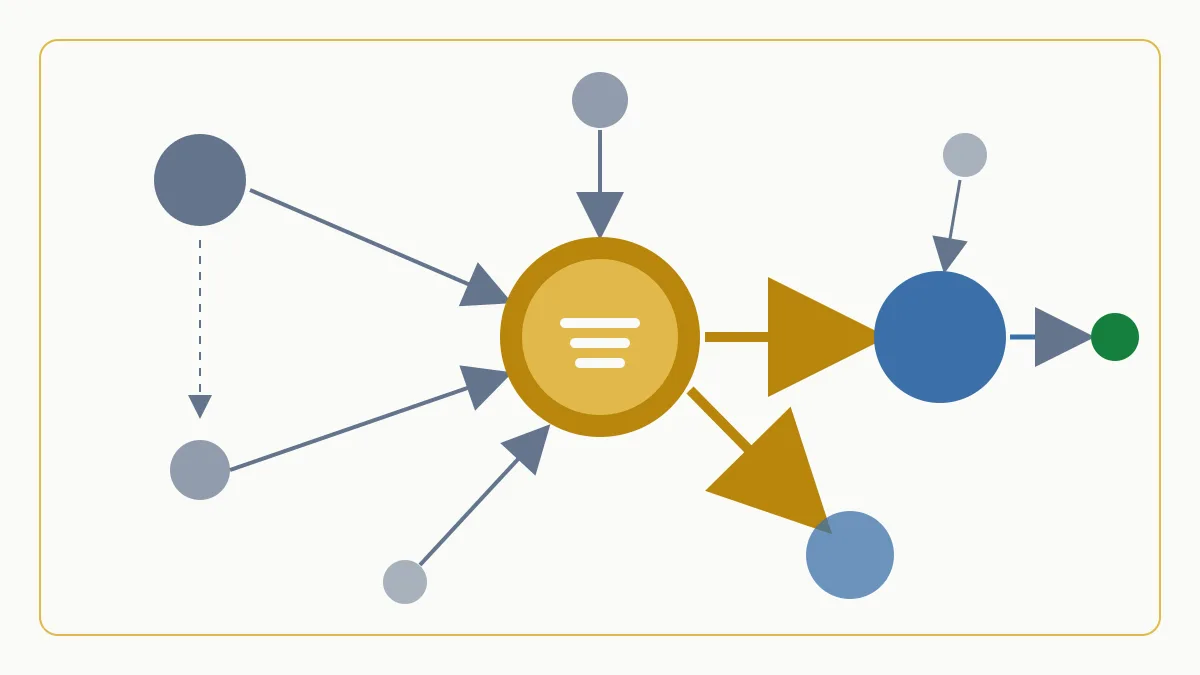
The term was popularised by the software company Moz with its Domain Authority metric. Over the years, other tools have created equivalent scores under different names: “domain rating”, “authority score”, “trust” and similar variants. They all answer the same question: given the links it receives, how strong does this domain look compared with the rest?
What they share is that none of them comes from Google. Each tool crawls the web on its own, builds its own link index and applies its own formula. That is why the same domain can score 22 in one tool and 35 in another without either being “wrong”: they measure similar things with different data and rules.
Google does not calculate domain authority or use any tool's version of it, and its spokespeople have said so publicly many times. What Google does have is its own link analysis system, PageRank, which works per page and for which it publishes no figure. They are two different things, even though they are often confused.
| Who calculates it | Each SEO tool, with its own link index |
|---|---|
| Usual scale | 0 to 100 |
| What it is based on | Mostly the links the domain receives |
| Does Google use it? | No |
| What it is useful for | Comparing domains with each other |
How it is calculated, broadly
Each tool keeps its formula to itself, but the general process is similar:
- Its own crawl. The tool goes through the web with its bot and records who links to whom. No tool sees the whole web, and each sees a different part of it.
- Counting referring domains. How many different sites link to you matters more than how many links you have in total: fifty links from one site count far less than fifty sites with one link each.
- The weight of each linking domain. A link from a domain that itself receives many links adds more than one from a newly created site.
- Its own adjustments. Some tools add other signals, such as estimated organic traffic or signs of artificial patterns.
- A relative scale. The result is placed on a scale that compares it with the other domains in the index. In the best-known ones the scale is not linear: going from 60 to 70 is much harder than going from 10 to 20.
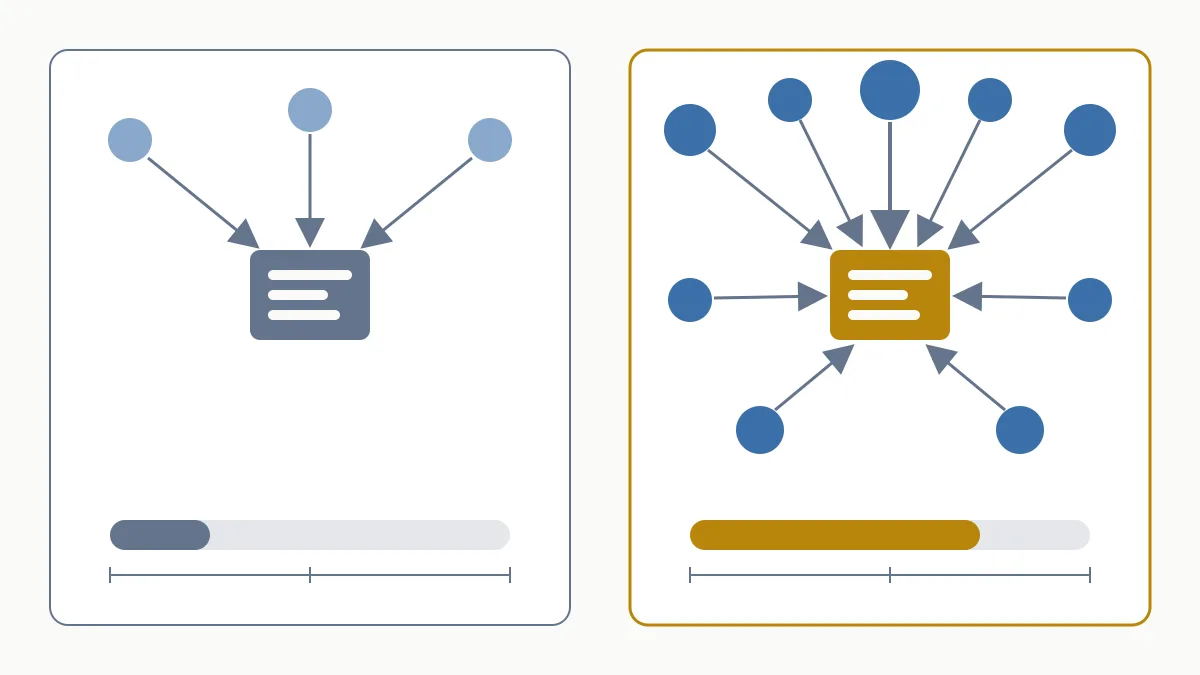
Two practical consequences follow. First, the figure can drop without you having done anything wrong, because the tool updated its index or formula, or because other domains grew. Second, it makes no sense to compare one tool's number with another's.
What it is good for and what it is not
| Good for | Not good for |
|---|---|
| Comparing your link profile with the competitors that show up for your searches | Knowing how Google rates you |
| A quick first filter of sites where you might earn a link | Deciding on its own whether a link is worth having |
| Watching the trend of your link profile over the months, always with the same tool | Measuring SEO results: clicks, rankings and enquiries tell you that |
| Estimating how hard it will be to compete for a search | Predicting that you will rank: pages on modest domains often outrank strong ones |
That last point is visible in the results every day. A page that answers exactly what is being searched, on a site specialised in the topic, can overtake a general portal with far more authority. Specialisation carries its own weight: we explain it in our article on topical authority.
What is a good domain authority?
There is no threshold for a “good” authority, and be wary of anyone who gives you one as if it were a rule. The figure only makes sense compared with that of the sites competing for the same searches as you.
An example: a dental clinic in Tarragona does not compete with a national newspaper or a university, but with the other clinics in the city. If those sit at low values, a slightly higher value is already a good starting point, even if it looks small in absolute terms. An online shop selling across Spain, by contrast, is up against competitors in a different league.
The useful way to look at it is to list five or six sites that appear on the first page for the searches you care about, check them all with the same tool and see where you stand. The gap between you and them, not the number on its own, is the data point.
How to improve domain authority
Since it is based on links, it goes up when you earn links from more domains and better ones. I recommend working on it in this order:
- Collect the links you are already entitled to. Suppliers, distributors, trade guilds, associations, the chamber of commerce, the town council if you work with it. These are real relationships and often all it takes is asking.
- Fix what is being lost. If you have changed URLs or domain and there are external links pointing to pages that no longer exist, 301-redirect them to the equivalent page.
- Publish something worth linking to. A well-made local guide, your own sector data, a calculator, a case study. Nobody links to a generic services page.
- Be visible where your sector is discussed. Local media, specialist blogs, interviews, collaborations. The detailed method is in how to get quality backlinks.
And two things to avoid: “high DA” link packages and mass link exchanges. They can push a tool's number up and, at the same time, break Google's policies against artificial links. Raising the metric while hurting your rankings is entirely possible.
If you would rather delegate it, see how we approach link building within our service.
Common mistakes
- Setting it as a goal. “Raise DA to 40” is not a business goal. The goal is visits and enquiries.
- Comparing figures from different tools. They are neither equivalent nor convertible.
- Panicking over a one-off drop. If traffic and rankings hold, the tool's index has most likely changed.
- Buying links for the number. A high-authority domain may be irrelevant to your sector or make its living selling links.
- Confusing it with PageRank. One comes from third-party tools and is per domain; the other belongs to Google and is per page.
- Accepting reports that only show this figure. An SEO report has to talk about clicks, searches and conversions.
Frequently asked questions
Does Google use domain authority?
No. It is a metric created and calculated by third-party tools. Google has its own link analysis systems and publishes no score.
How can I find out my site's domain authority?
With any SEO tool that calculates a metric of this kind; many offer a limited free check. Always use the same one so you can compare.
Why is my authority different in every tool?
Because each tool has its own link index and its own formula. The figures are not comparable across tools.
How long does it take to raise domain authority?
It depends on how fast you earn links from new domains and on when the tool detects them. It is not immediate and there is no fixed timeframe.
Are domain authority and page authority the same?
No. Domain authority rates the whole site; page authority rates a single URL. Both are tool estimates.
In short
Domain authority is a rough thermometer of your link profile, made by tools and not by Google. Use it to compare yourself with your real competitors and to follow the trend, and do not turn it into the goal. What counts is whether the pages you care about get visits and generate enquiries.
If you want to see how your site stands against the competitors in your area, on links and on everything else, ask us for a free initial analysis.