PageRank is the algorithm Google uses to measure how important a page is based on the links it receives: each link counts as a vote, and the vote weighs more the more important the page casting it. The public 0 to 10 toolbar score disappeared in 2016, but Google still uses PageRank, much evolved, as one of its ranking systems.
For a small business, the useful part is not the formula but its consequence: not all links are worth the same, and what you do with the internal links on your own site counts too. Here is the idea explained without unnecessary maths, the story of the toolbar and what you can do with it today.
What PageRank is
PageRank is the system Larry Page and Sergey Brin described in 1998, while they were PhD students at Stanford, and on which they built the first version of Google. The name plays on Page's surname and on “page” as in web page.
The intuition comes from academia: a scientific paper is more relevant the more papers cite it, especially if those papers are themselves widely cited. Page and Brin applied that logic to the web: a link is a citation. Until then, search engines ranked mostly on the text of the page, which was easy to manipulate by repeating words. Looking at who links to whom was a far harder signal to fake.
| What it measures | The importance of a page based on the links it receives |
|---|---|
| Unit | The page (URL), not the whole domain |
| Origin | Larry Page and Sergey Brin, Stanford, 1998 |
| Public score | None since 2016 |
| Current status | Still part of Google's ranking systems |
How PageRank works
The original idea comes down to three rules:
- Every link passes on importance. A page hands part of its PageRank to the pages it links to.
- What is passed on gets split. A page with many outgoing links gives less to each one than a page with few. A link from a page with five links is worth more than the same link from a page with five hundred.
- The calculation is circular and repeated. Because each page's importance depends on that of the pages linking to it, it is computed in successive rounds until the values settle.
The original paper explains it with the image of the random surfer: someone who keeps clicking links at random and, every now and then, gets bored and jumps to any page at all. A page's PageRank is the probability that this surfer is on it at a given moment. That “every now and then” is the damping factor, which the original paper usually set at 0.85.
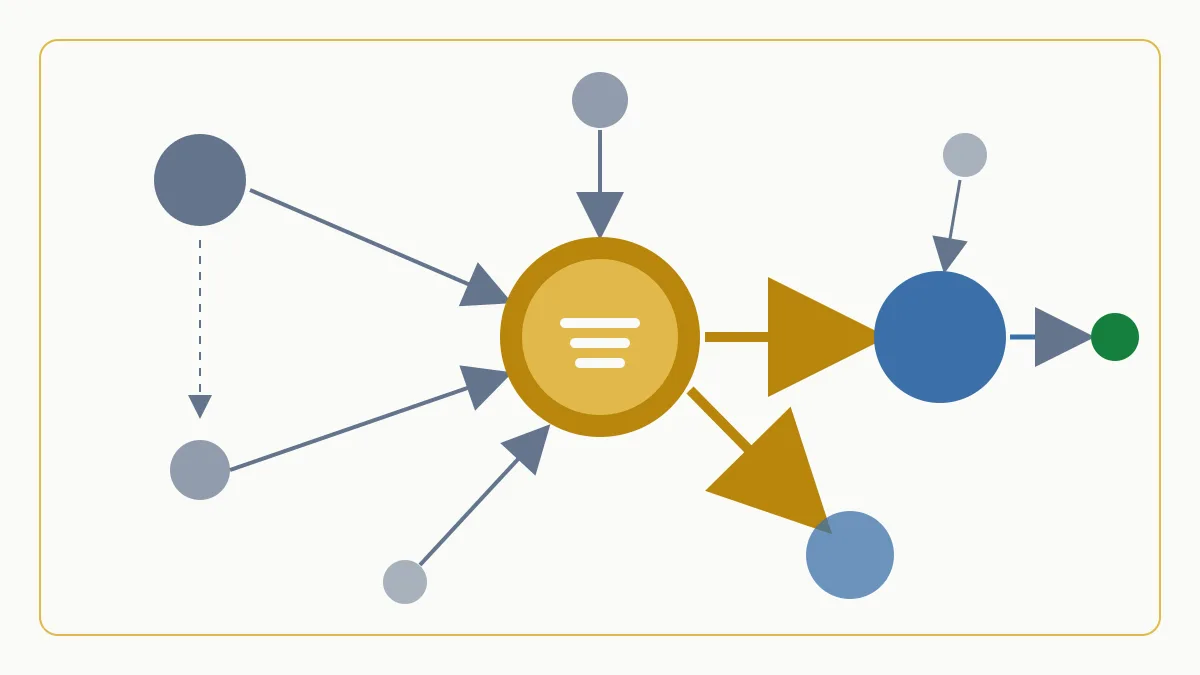
A simple example. Imagine an accountancy firm in Sabadell gets two links: one from the resources page of its professional association, which has few outgoing links and is cited by many other sites, and another from a generic directory with thousands of listings per page. According to the model, the first passes on far more than the second, even though both count as “one link” in a tally.
The PageRank toolbar and why it disappeared
From the year 2000, the Google Toolbar (a bar you installed in your browser) showed a simplified version of each page's PageRank: a score from 0 to 10 in a small green bar. It was the only Google figure anyone could see, and the industry turned it into currency: links were sold “from PR6”, domains were valued by their PR, and many webmasters worked to push the number up instead of improving the site.
Google stopped updating that public data in 2013 and removed it completely in 2016. The explanation it gave at the time was that a single figure had stopped being useful and confused site owners about what mattered. What disappeared was the thermometer, not the algorithm.
| Original PageRank (1998) | Toolbar PageRank (2000-2016) | PageRank today | |
|---|---|---|---|
| What it is | The algorithm described in the Stanford paper | A public score from 0 to 10 | One of Google's ranking systems |
| Can you look it up? | The formula is public | It no longer exists | No: Google publishes no value |
| Weight in rankings | It was the central signal | None: it was only an indicator | One signal among many |
What is left of PageRank today
Google says so in its guide to ranking systems: it has various systems that look at how pages link to each other to understand what they are about and which might be most helpful, and PageRank is one of them. The same guide adds that how it works has evolved a lot since launch and that it continues to be part of the core ranking systems.
What we do not know: how much it weighs, how it is calculated today or what value any given page has. Any tool or website offering to “check your PageRank” is showing you something else. Most often it is a tool's own metric, such as domain authority, which does not come from Google and which Google does not use.
There are three documented things worth knowing:
- Links marked with rel=“nofollow”, “sponsored” or “ugc” are treated differently: we explain it in our guide to nofollow and link attributes.
- Google also reads the visible text of a link to understand the destination page: this is what we call anchor text.
- Buying or selling links to manipulate rankings breaks Google's spam policies.
What it means for a small business
Not being able to see the number does not mean you cannot work on it. In the projects we review, this is what tends to move the needle, in order:
- A few good links before many bad ones. A link from a trade guild, a supplier, a local newspaper or an association in your sector makes sense to the reader and to Google. The full method is in what link building is.
- Internal links to the pages that sell. The home page is usually the one that gets the most external links. If your service pages are four clicks away or can only be reached from a drop-down menu, little reaches them. Link to them from the home page and from related articles.
- No orphan pages. A page with no internal links pointing to it is almost invisible to this model. In Search Console, the Links report shows which pages get the most internal and external links: start by checking whether the ones you care about are there.
- Proper redirects when you change URLs. If a page with external links disappears without a 301 redirect to its replacement, those links stop pointing anywhere.
If you want someone to help you earn links with good judgement, see how we approach link building for small businesses.
Common mistakes
- Searching for “my site's PageRank”. There is no official source. The figures you see are tool estimates.
- Counting links instead of weighing them. A hundred links from directories with no traffic are not worth one relevant link.
- Buying links “with authority”. Besides the risk of a penalty, you are paying for a metric Google does not use.
- Forgetting internal linking. It is the only part of the distribution you fully control, and it is often the most neglected.
- Thinking links are everything. PageRank is one signal among many: without content that answers the search, no link will fix it.
Frequently asked questions
Does Google still use PageRank?
Yes. Google's guide to ranking systems lists it as one of its core systems and notes that it has evolved a lot since the original version.
How can I find out my page's PageRank?
You cannot. Google removed the public score in 2016 and has not published a new one. What tools offer are their own metrics, not Google data.
Are PageRank and domain authority the same thing?
No. PageRank belongs to Google and is calculated per page. Domain authority is an estimate by third-party tools for a whole domain.
Do internal links pass PageRank too?
Yes, the model does not distinguish between internal and external links: both connect pages. That is why your internal link structure influences which pages on your site get more weight.
Why is it called PageRank?
After Larry Page, Google co-founder and co-author of the algorithm, with the double meaning of web “page”.
In short
PageRank is the idea that a link is a vote and that not all votes weigh the same. The toolbar died; the idea did not. For a business it comes down to two jobs: earning links from sites that make sense, and distributing internal links well towards the pages that bring in customers.
If you want to know which pages on your site receive links and which are left in the dark, ask us for a free initial analysis and we will show you with your own site's data.