To show up on Google Maps you need a verified Google Business Profile. To show up near the top, Google orders businesses by three factors it documents itself: relevance (how well the listing matches the search), distance (how far you are from the searcher) and prominence (how well known the business is). You cannot pay for a better position: you work on relevance and prominence.
- First: does the listing exist and is it verified?
- How Google orders map results
- Relevance: helping Google understand what you do
- Distance: the factor you cannot move
- Prominence: reviews and presence on the web
- How to rank first on Google Maps
- Why am I not showing? Quick diagnosis
- Frequently asked questions
First: does the listing exist and is it verified?
Everything below assumes the business already has a listing and you have verified it. Google lists verification as its first tip for improving local visibility. If you are not there yet, or there is a listing you do not manage, start with how to add my business to Google Maps and come back afterwards.
How Google orders map results
When someone searches for “physiotherapist” on their phone in Sabadell, Google picks which businesses to show on the map (the map pack, the highlighted local results) by combining three factors:
| Factor | What it measures | What you can do |
|---|---|---|
| Relevance | How well the listing matches what the user is looking for | A lot: category, services, description, complete information |
| Distance | How far the business is from the searcher, or from the place named in the search | Almost nothing: you are where you are |
| Prominence | How well known the business is: reviews and information found on the web | A lot, but over time |
Google does not publish how much each factor weighs, and states that it keeps the details of the algorithm confidential. Anyone quoting exact percentages is making them up.
Relevance: helping Google understand what you do
This is the factor with the most room for immediate improvement, because it depends on data you control.
- Primary category. It shapes which searches you can appear for. A firm in Girona categorised as “Consultant” is unlikely to show when people search for an accountant. Choose the most specific one that describes what the business is.
- Additional categories only for real, relevant services. Adding them just in case dilutes the message.
- Services and description. Write your services in the words customers use, not in trade jargon.
- Complete information. Google says businesses with complete and accurate information are easier to match with searches: address, phone, hours (including holidays) and attributes.
The detail of each field and the order to fill them in is in our guide to the Google Business Profile listing.
Distance: the factor you cannot move
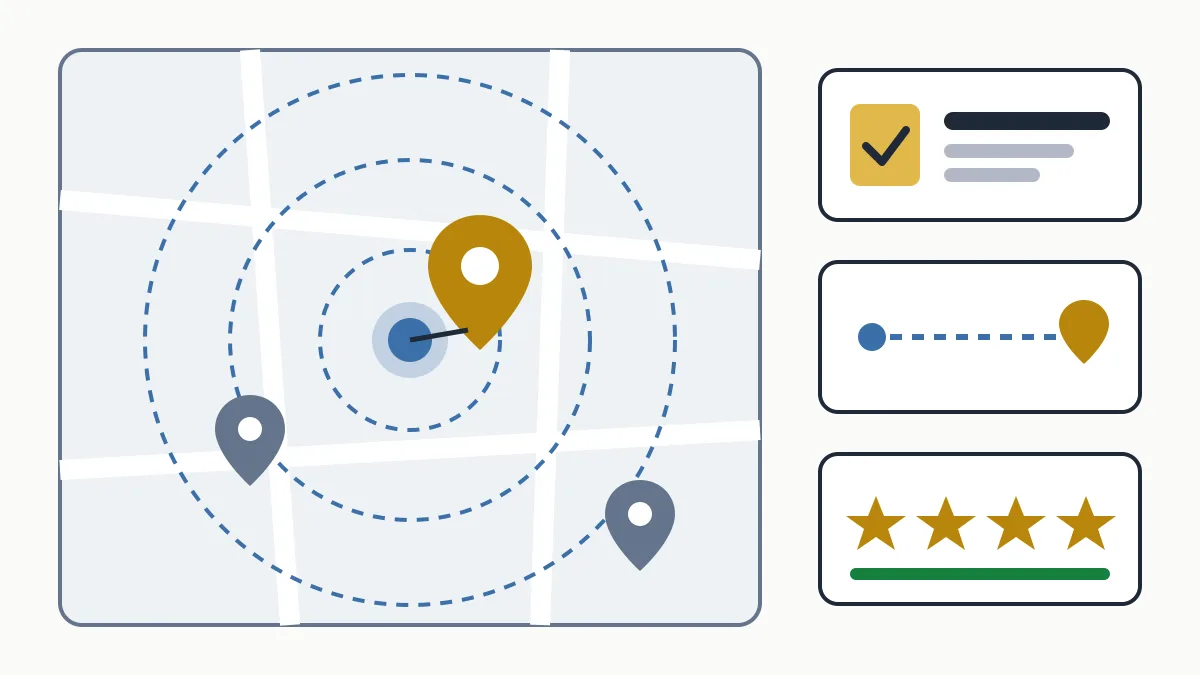
Google calculates the distance between the business and the searcher's location; if the user names a place in the search (“notary Reus”), it uses that place. This has two practical consequences:
- The result is not the same for everyone. A bakery in Sants can be first for someone searching from Sants and absent for someone searching from Poblenou. There is no single “position” on Google Maps.
- Cheating does not pay. Registering fake addresses or virtual offices to “be” in more places breaks the guidelines and can get the profile suspended.
What you can do: make sure the address and pin are correct, define your service area properly if you travel to customers, and work on your website so it appears in organic results for towns where you have no premises. That part is local SEO in the broad sense, explained in what is local SEO.
Prominence: reviews and presence on the web
Google defines prominence as how well known a business is, and bases it on the information it finds about the business on the web and on reviews. This is where position is decided between businesses that are equally relevant and equally close.
Reviews
- Ask for them systematically, right after a job well done. The method is in how to get Google reviews.
- Reply to all of them, including negative ones. Google explicitly recommends it.
- Offer nothing in return. Google's policies forbid incentivising reviews, and buying them puts the whole listing at risk.
Presence on the web
- Your own website linked from the listing, with the same name, address and phone number.
- Mentions on trusted local sites: trade guilds, retailers' associations, chambers of commerce, local media.
- Up-to-date photos. Google advises adding photos and videos because they show what the business offers.
How to rank first on Google Maps
The honest answer: nobody can guarantee first place, because position depends on where the searcher is and Google does not sell positions in local results. Ads are a separate product and are labelled as such. What you can do is be the strongest candidate in your area. In order of impact:
- Fix the primary category if it is not the most specific one.
- Complete every field and bring your hours up to date.
- Set up a system for requesting reviews every week, not a one-off campaign.
- Reply to pending reviews.
- Upload real photos and refresh them from time to time.
- Align name, address and phone across the listing, the website and directories.
- Strengthen the website: one page per service and, where it makes sense, per town.
The first two show results soon because they depend on you; reviews and the website take months of consistency. In-depth optimisation of each section is in the complete guide to Google My Business and local SEO.
Why am I not showing? Quick diagnosis
- The listing is not verified or is asking for verification again.
- It is suspended for breaking a guideline (often the name or the address).
- There is a duplicate and reviews are split between two listings.
- The category does not match the search you are testing.
- You are searching from too far away. Try the search from the area around the business, or add the town.
- You are searching for yourself. Searching for the business name says nothing about how you appear when someone searches for the service.
Frequently asked questions
Can you pay to rank higher on Google Maps?
No. Google states that you cannot request or pay for a better local ranking. Ads are a different product and are shown labelled as ads.
How long does it take to rank higher on Google Maps?
Changes to the listing (category, complete details) can show soon. Reviews and web presence are months of work. Google gives no timeframes.
Do more reviews mean a better position?
Reviews are part of prominence, one of the three factors. They help, but they do not make up for a wrong category or for distance.
Why do I show in my area but not in the next town?
Because of distance. Google favours businesses close to the searcher. To reach other towns, work on your website with specific pages for those areas.
Conclusion
Showing up on Google Maps depends on having a verified listing; ranking higher depends on being relevant to the search, being close and being known. You do not choose distance; you do choose relevance and prominence. If you want to know which of the three is holding your business back, ask us for a free initial analysis or see what our local SEO service includes.