Local SEO is the set of actions that make a business appear on Google when someone searches for a product or service in a specific area: on the map (the Google listing) and in organic results with local intent. If you want to know what local SEO is in one sentence: it is ranking for searches such as “dentist Girona” or “hardware shop near me”, where Google takes into account where the searcher is and where the business is.
What local SEO is and how it looks on Google
A local search is one where the useful answer depends on the place. There are two kinds:
- Explicit: the user types the place. “Employment lawyer Tarragona”, “bike repair Gràcia”.
- Implicit: they do not, but Google understands they want something nearby. “Pizzeria”, “pharmacy open”, “emergency plumber”.
In both cases Google usually shows two different blocks, and local SEO works on both:
- The map block (map pack): businesses with their listing, rating and hours. Your Google Business Profile competes here.
- Local organic results: websites of businesses, directories and local media. Your website competes here.
Who it is for (and who it is not)
| Type of business | Is it for them? | Why |
|---|---|---|
| Premises open to the public: shop, restaurant, clinic, hairdresser | Yes, it is the priority | Customers have to go there; they search nearby |
| Home services: plumber, renovations, cleaning, locksmith | Yes | Customers look for someone who works in their area |
| Professional practice: lawyer, accountant, architect | Yes | Trust and proximity weigh on the choice |
| Company with several branches | Yes, for each branch | Each location competes in its own area |
| Online-only shop selling nationwide | Hardly | No in-person service; it needs general and ecommerce SEO |
| B2B company with clients across the country | Secondary | Clients do not choose by proximity |
Rule of thumb: if most of your customers come from a radius you could draw on a map, local SEO is your first priority. A hardware shop in Vic or a veterinary clinic in Mataró has far more to gain there than by competing for generic terms nationwide.
How it differs from general SEO
Local SEO is not a separate discipline: it is SEO with a geographic layer on top. Everything that holds for any website (useful content, sound technical basics, authority) still holds. What changes is this:
| General SEO | Local SEO | |
|---|---|---|
| Target searches | No place component | Explicit or implicit place |
| Where you appear | Organic results | Map and local organic results |
| Your own asset | The website | The website and the Google listing |
| What also counts | — | Distance from the searcher |
| Reputation | Links from other sites | Links, reviews and local mentions |
| Competition | The whole market | Businesses in your area |
The difference that surprises people most is distance: the result changes depending on where the search is made. Google documents that it orders local results by relevance, distance and prominence; we explain it in detail in how to show up on Google Maps.
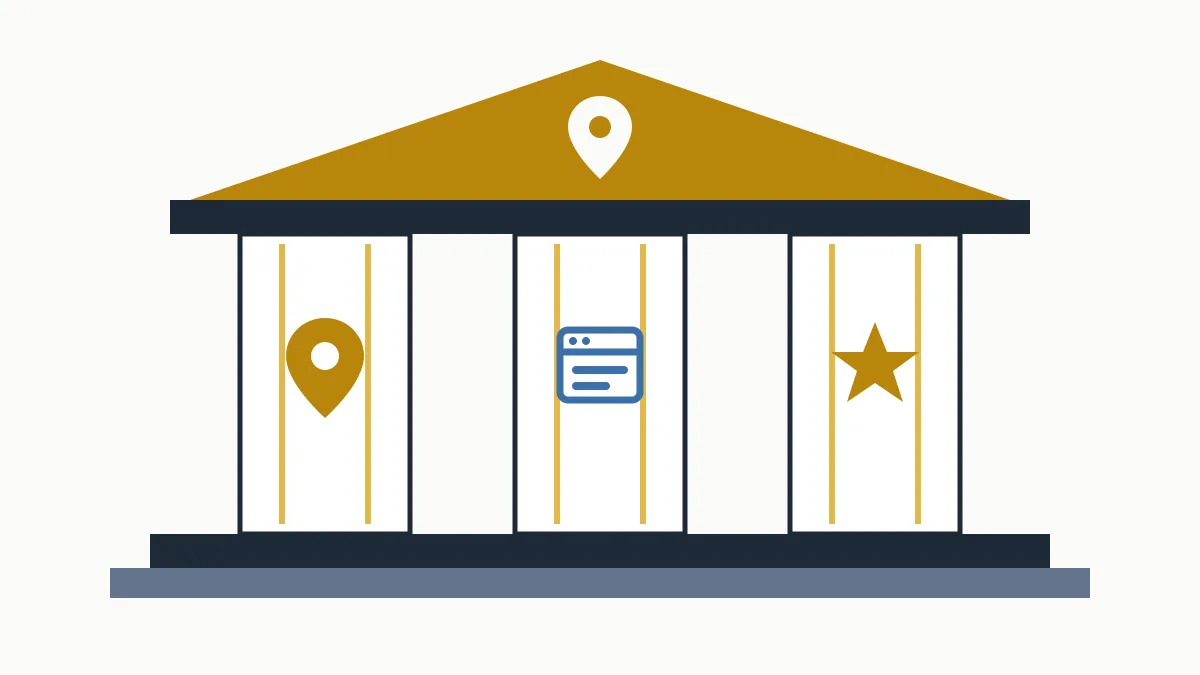
The three pillars of local SEO
1. The Google listing
Your Google Business Profile is what competes on the map. It has to be verified, with the real name, the right category, up-to-date hours and your own photos. If you do not have one yet, sign-up is covered in how to add my business to Google Maps; if yours is half finished, see our guide to the Google Business Profile listing.
2. A website with local signals
The website is what competes in organic results and what gives the listing context. In local terms that means:
- Name, address and phone visible and identical to the listing.
- One page per service and, where there is real demand, per town you serve, with its own content rather than the same template with the town name swapped.
- Local business structured data, which helps Google understand your address, hours and type of business. It is explained in the structured data guide.
- A good mobile experience: people searching nearby are often on their phone, intending to call or visit.
3. Local reputation
This is what is said about you outside your own website:
- Reviews on Google: number, rating and, above all, consistency. Plus replies from the business.
- Local mentions and links: trade guilds, retailers' associations, town councils, local media, reputable industry directories.
- Consistent details: the same name, address and phone wherever the business appears.
The three pillars reinforce each other. A listing with good reviews that links to a clear website works better than any of the three pieces on its own.
What local SEO is not
- It is not advertising. Google's local ads are paid and disappear when you stop paying. Local SEO works on unpaid results.
- It is not stuffing the listing name with keywords. That breaks Google's guidelines.
- It is not creating twenty identical pages with only the town name changed.
- It is not a one-day job. The listing can be put right quickly; reviews and website authority are built over months.
Where to start
This article is the definition. The execution, with steps and priorities, is in the local SEO guide for businesses in Catalonia. If you want a minimum order of work: first a verified and complete listing, then consistent details across listing and website, then a system for requesting reviews, and finally service and town pages.
Frequently asked questions
What is local SEO in a few words?
It is the work that gets a business onto Google when someone searches for what it offers in a specific area, both on the map and in organic results.
Is local SEO just the Google listing?
No. The listing is one of three pillars. The other two are a website with local signals and reputation: reviews and mentions.
Do I need a website to do local SEO?
You can appear on the map with the listing alone, but without a website you give up the organic results and the chance to explain why people should choose you.
Does local SEO work if I have no premises open to the public?
Yes, if you serve customers in person by travelling to them. Google allows service-area businesses, with a defined area and no address shown.
Conclusion
Local SEO is SEO designed for people searching near you: Google listing, a website with local signals, and reputation. If your business lives off customers in the area, this is where to start. If you want to know where you stand on each of the three pillars, ask us for a free initial analysis or see how we work on local SEO.