International SEO is the set of technical and content decisions that make Google show the right version of your website in each country and language. It rests on three pieces: a URL structure per market (country domain, subfolder or subdomain), hreflang tags that tie the versions together, and content that is genuinely localised, not translated in a hurry.
For a Catalan SME that exports, the good news is that you do not need one website per country. The bad news: most mistakes are made on day one, when choosing the structure, and later they cost a migration.
Language or country: what exactly do you need?
Before touching anything, separate two things that often get mixed up:
- Multilingual site: the same content in several languages (Catalan, Spanish, English). You are not targeting a country, but whoever speaks the language.
- Multi-regional site: versions designed for specific countries, even if they share a language (French for France and French for Belgium, with different prices and shipping).
A Penedès winery selling to German restaurants needs a German version with terms for Germany: that is multi-regional. A machinery manufacturer in Sabadell receiving enquiries in English from half the world can start with one good English version and no country. The fewer versions you have to maintain well, the better.
URL structure: ccTLD, subfolders or subdomains
Google recommends giving each version its own URL, rather than switching language with cookies or browser settings. From there, you have three serious options and one to avoid:
| Structure | Example | Pros | Cons |
|---|---|---|---|
| Country domain (ccTLD) | yourbusiness.fr | Very clear country signal; local trust | Each domain starts from zero authority; more cost and upkeep |
| Subfolders on a generic domain | yourbusiness.com/fr/ | All authority on one domain; easy to maintain | Weaker country signal; a single infrastructure |
| Subdomains | fr.yourbusiness.com | Each market can be hosted and managed separately | More technical complexity; the split is less clear to users |
| URL parameters | yourbusiness.com/?lang=fr | None that matter | Not recommended by Google |
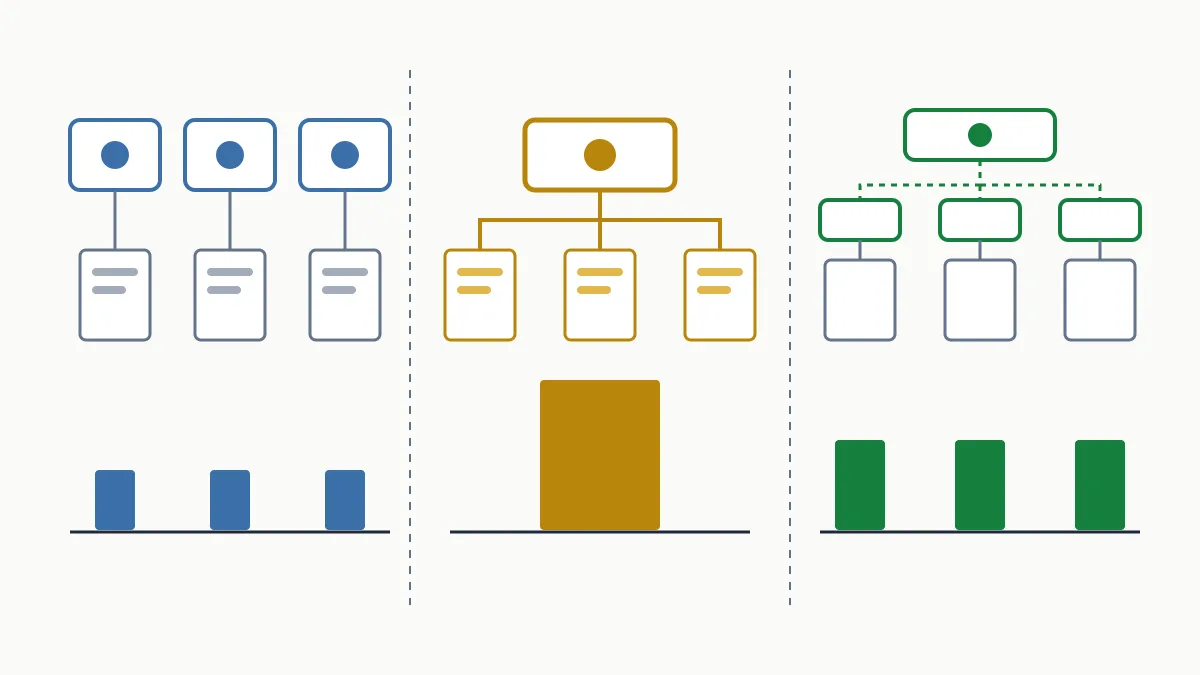
My recommendation for most SMEs is subfolders on a generic domain (.com, or .cat, which is not a country domain): one project to maintain, and every link you earn helps all versions. Country domains make sense when you have a team, stock or a legal entity in the target market.
The international structure has to fit the rest of the site; if yours is still undefined, go through the guide to SEO site architecture first.
Hreflang without errors
Hreflang is the annotation that tells Google: “this page has these other versions for these languages or countries”. It does not raise rankings; it makes sure the French user gets the French URL and not the Spanish one. It can be declared in three equivalent ways: with tags in the <head>, in HTTP headers (useful for PDFs) or in the XML sitemap.
<link rel="alternate" hreflang="ca" href="https://yourbusiness.com/ca/vins/" />
<link rel="alternate" hreflang="es" href="https://yourbusiness.com/es/vinos/" />
<link rel="alternate" hreflang="de-DE" href="https://yourbusiness.com/de/weine/" />
<link rel="alternate" hreflang="x-default" href="https://yourbusiness.com/en/wines/" />
The rules that get broken most often:
- It must be reciprocal. If the Catalan page points to the German one, the German page must point back. Without the return link, Google may ignore the annotation.
- Each page lists itself, as well as every other version.
- Correct codes: language in ISO 639-1 and, if needed, region in ISO 3166-1 Alpha 2. The United Kingdom is
en-GB, noten-UK. A country on its own is not valid: always language, or language plus country. - Full URLs, with protocol and domain, returning a 200.
- x-default for the version to show when no language matches.
A detail that saves trouble: Google does not determine a page's language from hreflang or from the lang attribute, but from the visible content. A “German” page with the menu, the footer and half the text in Spanish is a confusing page. If you would like us to check it, it is part of what we cover in technical SEO.
Localised content, not translated
Translating changes the words; localising makes the page work for someone buying from there. The difference shows in sales before it shows in rankings.
- Keyword research per market. The literal translation of a search is almost never the search people actually make. Do the keyword research in each language, not once.
- Commercial details for the country: currency, taxes, delivery times and costs, returns, usual payment methods.
- Trust signals: phone number with international prefix, address, legal texts in the language, support in that language (if you cannot offer it, say so).
- Formats: dates, units, sizes, decimals.
- Translated URLs and metadata: slug, title and description in the page's language.
I recommend starting with a few well-made pages (home, main categories or services, contact) rather than rushing a translation of the whole catalogue. For online shops, the groundwork for categories and product pages is in the ecommerce SEO guide.
Common international SEO mistakes
- Automatically redirecting by IP or browser language. Google advises against it: its crawler usually comes from United States addresses and may never see the other versions. A discreet notice linking to the suggested version is better.
- Canonical pointing to another language. Each version should be canonical to itself; if they all point to the Spanish one, the others disappear.
- Hreflang with no return link, or pointing to URLs that redirect or return errors.
- Mixing languages on one page: main text translated and the rest not.
- Translating only the home page and letting every other link lead back to the original language.
- Looking for the old International Targeting report in Search Console to “assign a country”: Google retired it. Today the country is communicated through structure, hreflang and content.
- Measuring everything together. If you do not filter by country, a market that is not taking off hides behind the one that works.
Where to start: recommended order
- Look at the demand you already have. In the Search Console performance report, filter by country: there are often impressions from France or Germany before you have done anything. If you are not at home with it, there is the guide on how to use Search Console.
- Pick one market, not five. The one already buying from you, or the closest logistically.
- Decide the structure with future markets in mind.
- Localise the pages that sell and implement hreflang on all versions at once.
- Measure by country for a few months before opening the next.
Frequently asked questions
Do I need a different domain for each country?
No. A generic domain with one subfolder per language or country works and is easier to maintain. Country domains pay off when you have a real presence in the market.
Does hreflang improve rankings?
Not directly. It helps Google show each user the appropriate version, and stops the wrong version appearing in another country's results.
Can I do international SEO on a .es domain?
You can have versions in other languages, but .es is a country domain and signals Spain. To rank in other countries, a generic domain or the target country's domain is a better choice.
Is machine translation good enough?
As a draft, yes. Published unreviewed, it shows: vocabulary nobody searches for and copy that does not build trust. Always have a native speaker review it, at least on the pages that sell.
Which country should I start with?
The one already sending signals: filter the Search Console performance report by country and see where impressions and queries come from. Open one market and measure it before the next.
In short
International SEO is not about translating the website, but about getting three decisions right: where each version lives, how you connect them, and what someone buying from abroad finds there. If you want to know whether your site is ready to open a new market, ask us for the free initial analysis and we will tell you where to start.