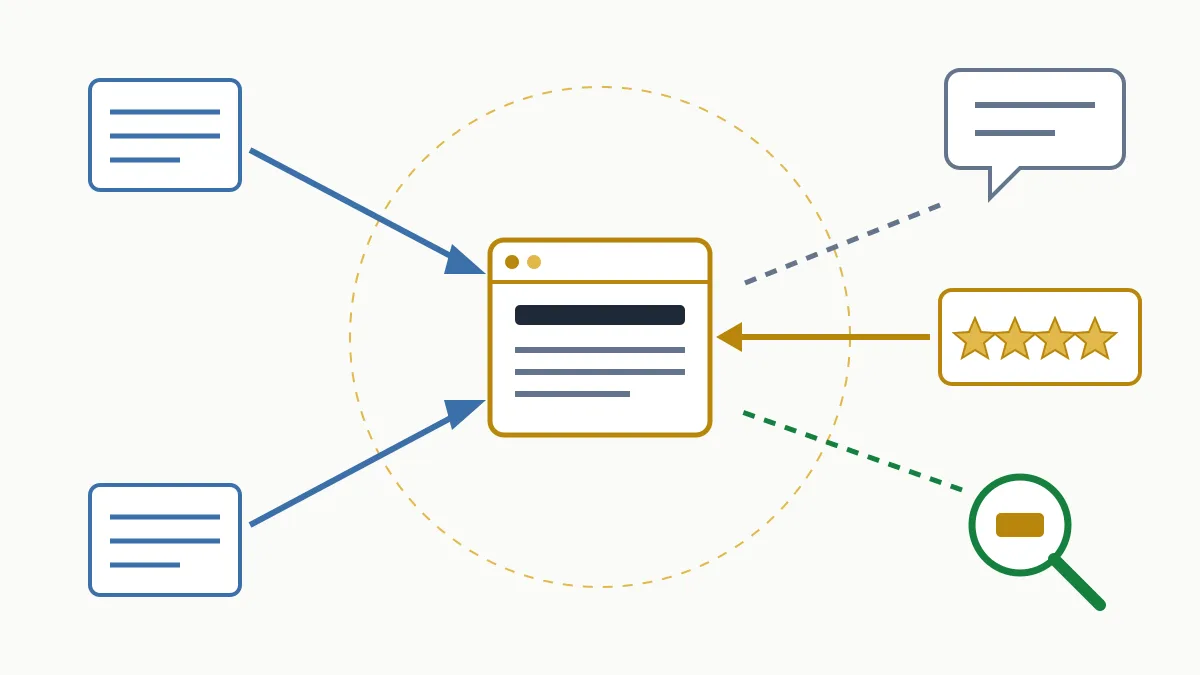
Off-page SEO is everything that happens outside your website and influences how Google values it: the links you receive from other sites, mentions of your brand, reviews and the reputation of the business. If on-page SEO says what a page is about, off-page says whether it deserves trust. You do not fully control it: it is earned.
Here are the four signals, which one weighs most for your type of business and what to avoid. For the bigger picture, see what SEO is.
What off-page SEO is
“Off page” means outside the page. It covers any signal about your business that Google finds in places that are not your domain: another site linking to you, a local newspaper quoting you, the stars on your Google Business Profile. The part that does depend on you, page by page, is on-page SEO.
The underlying idea is simple: Google does not rely only on what a site says about itself. It also looks at what others say.
The four signals outside your site
| Signal | What it is | How it is earned |
|---|---|---|
| Links | Another site links to one of your pages | By being worth citing: useful content, relationships in the sector, presence where it matters |
| Mentions | People talk about your business without linking to it | Local press, associations, sector directories, events |
| Reviews | Customer opinions on your Google Business Profile and other platforms | By asking for them systematically and replying to them |
| Brand | People searching for you by name | By doing the work well and being memorable |
Links
Google uses links to discover pages and as one of the signals to assess them: a link from a relevant site in your sector works like a recommendation. Where it comes from matters, not how many you have. A link from the installers’ trade association to an air conditioning company in Terrassa is worth more than fifty from directories nobody visits.
How to earn them is a topic of its own and I will not repeat it here: you have what link building is and how to get quality backlinks.
Mentions
Google has not confirmed that a mention without a link counts like a link, and I would not treat it as one. What a mention does do is make you known: someone who reads about you in the local paper later searches for you by name, and sometimes the mention ends up becoming a link. For local searches, Google also explains that a business’s prominence is based on the information it finds about it across the web, such as links, articles and directories.
Reviews
In local searches this is the most direct signal: Google states that review count and review score factor into local ranking. And before Google reads them, the customer does. Ask every satisfied customer, and reply to every review, good or bad. The system for both is in how to get Google reviews and in the guide to managing reviews.
Brand
People searching for “Vila Carpentry Girona” instead of “carpenter Girona” is not a factor Google has documented as such. I treat it as the thermometer for everything else: if searches for your name grow in Search Console, the business is becoming known. And whoever searches for you by name has already decided.
What weighs most by type of business
| Type of business | Where I would put the effort first | Why |
|---|---|---|
| Local with nearby customers (restaurant, clinic, garage) | Reviews and Google Business Profile | The competition is on the map, and that is where they count |
| Professional services (law firm, accountancy, engineering) | Links and mentions from the sector | Professional bodies, associations and specialist media give credibility |
| Online shop | Links to categories and guides | You compete with sites from the whole country |
| Business selling to other businesses | Brand and mentions in trade media | Few searches, slow decisions, reputation carries weight |
It is a guide to order, not a rule: in the end all four signals add up.
How to check where you stand
- Links: in Google Search Console, the “Links” report shows which sites link to you and which of your pages receive the most links.
- Reviews: on your Google Business Profile, how many you have, when the last one was left and how many you have answered. Compare with the three businesses on the map for your main search.
- Brand: in Search Console, filter the queries that contain your name and watch the trend.
- Mentions: search for the business name in quotation marks on Google and see who talks about it.
What is not off-page SEO (and costs you)
- Buying links or “500 backlinks” packages. Google’s policies treat this as link spam: it may ignore them or apply a manual action.
- Fake or incentivised reviews. They break Google’s rules and can end with the reviews removed.
- Mass exchanges of the “you link to me and I link to you” kind with unrelated sites.
- Listings in dozens of irrelevant directories. Wasted time; the ones your customers really use are enough.
Where a small business starts
- A complete Google Business Profile and reviews. It is what moves fastest and it depends on your daily work. The profile side is in the guide to Google My Business and local SEO.
- The links that are already yours to claim. Suppliers, customers, trade body, local retailers’ association: real relationships not yet reflected on the web.
- Something worth citing. A guide, your own data, a well-explained case. Without that there is nothing to link to.
If you would like us to take care of it, see what the link building service includes.
Frequently asked questions
What is the difference between on-page and off-page SEO?
On-page is what you optimise inside your site: content, titles, internal links. Off-page is the set of signals that come from outside, such as links, mentions and reviews, and that speak to the reputation of the business.
Are off-page SEO and link building the same thing?
No. Link building is the part of off-page that works on links. Off-page also includes reviews, mentions and brand, which can weigh more for a local business.
Does social media count as off-page SEO?
It is not a direct ranking signal that Google has documented. It helps make the business and its content known, and brand searches and links can come from that.
How many links do I need to rank?
There is no number. It depends on who competes for that search and on the quality of the links. A few from relevant sites in your sector are worth more than many from unrelated ones.
Can I do off-page SEO with no budget?
Yes, in the part that matters most to a local business: asking for reviews, completing the Google Business Profile and getting suppliers and associations you already work with to link to you.
Off-page SEO is your business’s reputation seen from the outside: it is earned, not bought. If you want to know which signals you are missing compared with your competitors, ask for the free initial analysis.