An SEO strategy is the plan that decides which searches you want to win, with which pages, in what order and how you will know whether it is working. It is not a list of tricks: it is choosing. For a small business it comes down to eight steps (diagnosis, goals, keywords, content, technical health, authority, measurement and calendar) and fits in a two- or three-page document anyone in the company can understand.
What an SEO strategy is and is not
Optimising a title, publishing an article or earning a link are tactics. The strategy is what decides which tactics apply, to which pages and in what order, because a small business has neither the hours nor the budget to do everything. If you are still unsure what organic search is, start with what SEO is and come back afterwards.
What I find most often is not a bad strategy but none at all: content goes out when there is time, on whatever feels interesting, and nobody checks whether it brings in customers. The eight steps below are the order in which I plan it.
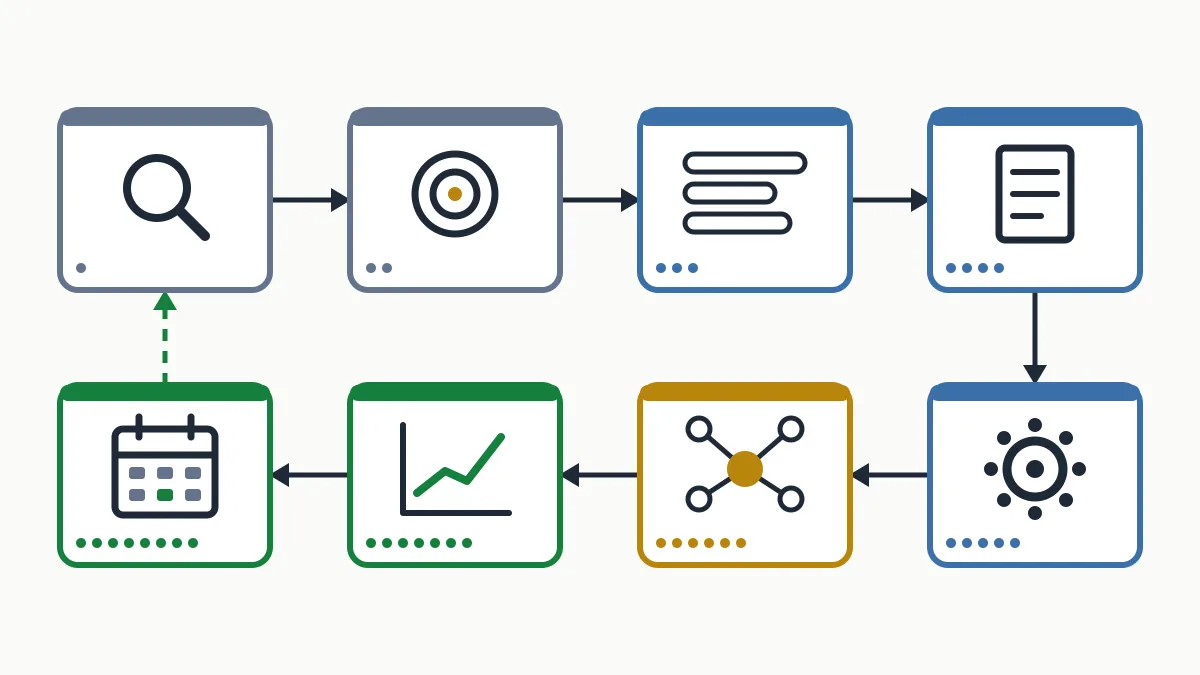
1. Diagnosis: where you are starting from
Before deciding anything, three snapshots:
- The site: which pages it has, which are indexed and which get visits from Google. Search Console gives you this for free.
- The business: which services carry the best margin, which you want to sell more of and in which area.
- The competition on Google, which is not always the competition down the street: for many searches you are up against directories and portals, not the firm next door.
Doing this in depth is an audit, which I explain in what an SEO audit is.
2. Business goals, not ranking goals
“Rank first for carpenter Girona” is not a goal; at best it is a means. A useful goal looks like this: go from four to ten quote requests a month from organic search within twelve months. It is about the business, it has a number and it has a deadline.
With two or three goals like that you can start ruling things out. If an action brings you no closer to any of them, it stays out of the plan, however interesting it sounds.
3. Keywords: where there is demand you can win
This is where you decide which searches get your effort. The full method is in how to do keyword research step by step; for strategy purposes the result only needs to be ranked by three criteria:
- Demand: someone genuinely searches for it.
- Intent: whoever searches wants to hire or buy, not just read.
- Feasibility: the first page is not entirely made up of portals you cannot compete with today.
For a local business, the top of the list is usually service-plus-town combinations (“bathroom renovation in Terrassa”) ahead of the generic term: these are long-tail keywords.
4. Content map: one search, one page
Every priority search should have one single page assigned to it. Draw up a table with three columns: search, page that targets it and status (exists and works, exists and needs improving, needs creating).
Three work lists come out of it: service pages to improve, new pages to create and supporting articles that answer pre-purchase questions and link to the services. If two pages compete for the same search, decide which one stays: that is what I cover in SEO cannibalisation. For the day-to-day writing, see how we handle content.
5. Technical health: nothing should hold the rest back
Technical work does not lift rankings on its own, but it can stop everything else from counting. For a small business, the strategy only needs to set the minimums:
- Important pages can be crawled and are indexed.
- The site looks and works well on a phone.
- It loads at a reasonable speed.
- There are no duplicate versions of the same page and no broken internal links.
Each point is covered in detail in what technical SEO is.
6. Authority: who talks about you
Google uses links from other sites as one of the signals for working out which pages deserve trust. For a small business, a realistic authority strategy rests on three things: a complete Google Business Profile with reviews, local and industry mentions (trade body, retailers' association, suppliers, local press) and some content worth linking to. No buying link packages: the reasons are in black hat SEO.
7. Measurement: decide beforehand what you will look at
Pick three or four indicators tied to the goals from step 2 and write down the starting value before you begin. Which indicators exist and how to read them is in SEO KPIs, and how to set up tracking is in how to measure SEO results. What the strategy must put in writing is how often it is reviewed (once a month is enough) and who does it.
8. Calendar: what turns the plan into work
Without dates, everything above is a statement of intent. An indicative split for a small business starting out:
| Period | What gets done | What you should be able to see |
|---|---|---|
| Month 1 | Diagnosis, goals, keywords and content map. | The strategy document, closed. |
| Months 2 and 3 | Technical minimums, Google Business Profile and improvements to existing service pages. | Pages indexed and error-free. |
| Months 4 to 6 | New pages and supporting articles at a steady pace; first mentions. | More impressions in Search Console. |
| Months 7 to 12 | Reinforce what is rising, fix what is not and extend to new searches. | Organic enquiries tracked against the goal. |
These are orders of magnitude, not promises: the pace depends on your starting point and the competition, as I set out in how long SEO takes to work.
Common mistakes when planning an SEO strategy
- Starting with the blog while the service pages, the ones that sell, are half finished.
- Chasing the most generic term (“lawyer”) instead of the one you can win (“employment lawyer in Lleida”).
- Setting ranking goals instead of goals for enquiries or sales.
- Changing the plan every month because results are not visible yet.
- Not recording the starting point and being unable to show later what changed.
If you want a starting point built on your own site's data, ask us for a free initial analysis: we tell you where you stand on steps 1, 3 and 5 and where we would begin.
Frequently asked questions
What should an SEO strategy include?
A starting diagnosis, business goals, priority searches, a content map with one page per search, technical minimums, an authority plan, tracking indicators and a calendar with dates and owners.
How long does it take to put an SEO strategy together?
For a small business with an average-sized site, planning it usually takes two to four weeks, depending on the data available. Carrying it out is a matter of months.
What is the difference between SEO strategy and SEO tactics?
Tactics are specific actions, such as optimising a title or earning a link. The strategy decides which tactics are applied, to which pages and in what order to reach a goal.
How often should an SEO strategy be reviewed?
The indicators, once a month. The whole plan, every six to twelve months, or sooner if the business changes: a new service, a new area or a new website.
Can I do the SEO strategy myself?
Yes, if you put in the time and have access to Search Console. The hardest part from the inside is prioritising and discarding; that is why many small businesses commission the planning and then carry out part of it in-house.