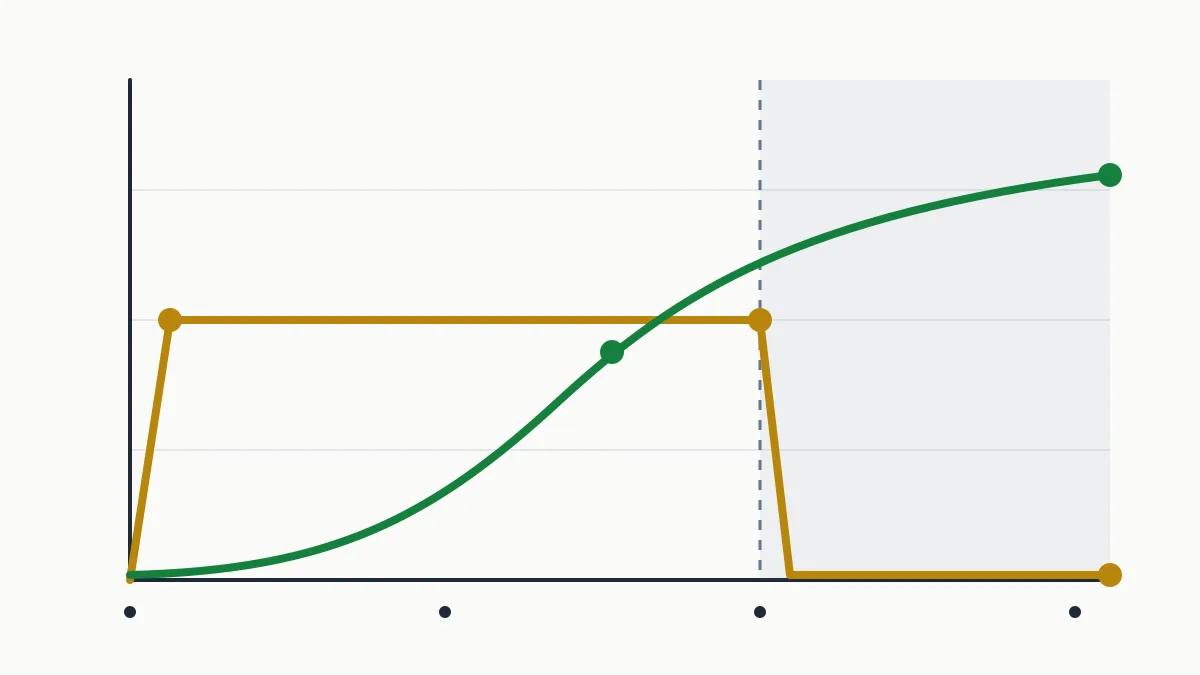
What is SEO and SEM? SEO (Search Engine Optimization) is the work of improving a website so that it appears in Google's free results. SEM (Search Engine Marketing) is, in everyday use, paid advertising on search engines: ads that show at the top with a “Sponsored” label and that you pay for per click. SEO takes months and compounds; SEM works the same day and stops when you stop paying.
Both aim for the same thing: that whoever searches for what you offer finds you. What changes is how you get there, how long it takes and what happens when you stop. Here are the differences laid out clearly and a way to judge which one suits you at each moment.
What SEO is
SEO is the set of improvements that help Google understand your site, consider it useful and show it in the organic results, the ones that are not ads. It covers the technical side (the site can be crawled and loads well), the content (it answers what people search for) and reputation (other sites and customers talk about you). We explain it in more detail in what is SEO.
You do not pay Google for each visit, but you do invest hours or a provider. And it takes patience: the usual pattern is to start seeing results three to six months in, as we explain in how long SEO takes to work.
What SEM is
Strictly speaking, SEM means search engine marketing and could cover everything, SEO included. In practice, when an agency or a quote says SEM it means paid search ads, mostly through Google Ads. You choose which searches you want to appear for, write the ad, set a daily budget and pay when someone clicks.
The advantage is speed and control: you can launch a campaign today, limit it to Girona and the surrounding area and pause it on Friday. The limit is just as clear: no budget, no visits.
Differences between SEO and SEM
| SEO | SEM | |
|---|---|---|
| Where you appear | Organic results | Ads labelled “Sponsored” |
| What you pay for | Work (hours or a provider) | Each click, plus management |
| When it shows | In months | The same day |
| If you stop | Rankings hold for a while | Visits stop at once |
| Control | Google decides the position | You decide searches, area, schedule and budget |
| Best for | Stable demand and a long-term view | Urgency, campaigns and tests |
When to use SEO and when SEM
SEM fits better when:
- You have a date: a language school in Girona opening enrolment in September cannot wait six months.
- You are launching a new service and the site has no rankings yet.
- You want to check whether a search brings customers before investing content in it.
- Your margin per sale can absorb the cost of the click.
SEO fits better when:
- Demand is steady all year, as with a law firm in Lleida or a physiotherapy clinic in Sabadell.
- The cost per click in your sector is high and every paid visit eats into the margin.
- Your customers compare and read before deciding, and need to find answers from you.
- You want to stop depending on a monthly ad budget.
If your question is where to put the money first, with numbers and scenarios, we develop it in SEO vs Google Ads: which to choose first.
How they complement each other
They are not rivals. Combined well, each covers the other's weak spot:
- Ads cover the wait. While SEO matures, SEM brings visits for the most profitable searches.
- Ad data guides content. The search terms report in Google Ads shows which exact words bring enquiries; those deserve a well-built page of their own.
- SEO makes SEM cheaper. As you rank for a search, you can cut ad spend there and move it elsewhere.
- A good page serves both. A clear, fast service page converts better whether the visit comes from an ad or from an organic result.
Three common misconceptions
- “If I pay for ads, Google will rank me higher.” No. Google states it explicitly: advertising does not improve your position in the organic results.
- “SEO is free.” You do not pay for the click, but you do pay for the work. Without hours put in, there are no results.
- “SEM is only for big companies.” You can limit it to one town and a small daily budget. What you need is to measure enquiries, not only clicks.
Where to start
Before choosing, look at where you stand: which searches already bring you visits and which do not. Our free initial analysis puts it in front of you. And if you want to do both under a single approach, see how we run SEM coordinated with SEO.
Frequently asked questions
What do SEO and SEM stand for?
SEO is Search Engine Optimization: optimising a site to appear in the free search results. SEM is Search Engine Marketing and, in practice, is used to mean paid ads on search engines such as Google Ads.
Which is better, SEO or SEM?
It depends on the timeframe. If you need visits this week, SEM. If you want a steady flow without paying for each click, SEO. Most businesses end up combining them.
Does running Google Ads improve my SEO?
Not directly. Paying for ads does not change your position in the organic results. What it does give you is data on which searches bring customers.
How long does each take to work?
SEM can bring visits the same day the campaign goes live. SEO usually needs three to six months to show results, depending on competition and the state of the site.
Can SEO and SEM be done at the same time?
Yes, and it is usually the best option. Ads provide immediate visibility and data, and SEO reduces dependence on the ad budget over time.